
Contents
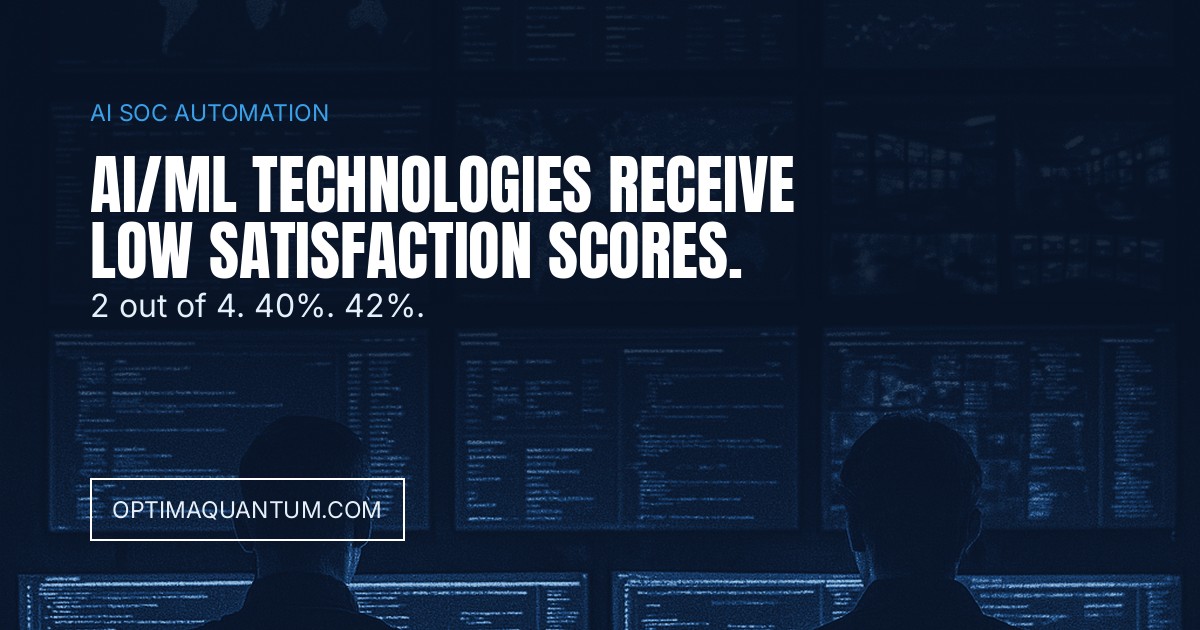
AI-driven SOC automation is sold as the fix for analyst burnout and alert overload. But the sector’s most-cited annual survey, the SANS SOC Survey 2025 (security operations professionals in 57 countries, published July 2025), says something different: of the three AI/ML technologies it measures, two landed at the bottom of the satisfaction table — generative AI scored 2 out of 4, lower than any other SOC technology. EDR/XDR, mature and well-integrated, is the only technology above 3 out of 4. AI isn’t a bad technology here. It’s the one being deployed the worst.
What the SANS 2025 survey actually says
SANS has spent nine years asking real SOC teams — analysts, security administrators, managers — what they use and how much they trust it. The 2025 edition, written by Christopher Crowley (senior SANS instructor, 25 years in the field) and sponsored by Elastic, surfaces three numbers that rarely make it into a vendor demo:
- Of the three AI/ML technologies measured, two ranked last in satisfaction, including generative AI at 2 out of 4. EDR/XDR, by comparison, is the only SOC technology above 3 out of 4 — and it has held the top spot for years.
- 42% of teams deploy their AI/ML tools “out of the box”, with no customization for their own environment.
- 40% of SOCs use AI/ML actively but outside the approved workflow — not rejected, not governed, just there, running on its own.
As Seth Misner, SANS Faculty Fellow and author of several SANS courses on AI-driven defense, puts it in the report itself: “SOCs struggle to hire and retain qualified analysts, while AI/ML and automation are the most-planned expansions, despite delivering the least value according to the survey itself. AI should augment analysts, not replace them. I worry leadership sees AI as a shortcut to fill staffing gaps instead of investing in the talent and careful integration that actually improve a SOC.”
The problem isn’t the AI. It’s how it gets deployed
SANS itself puts it in a line that should sit inside every automation proposal: “If company leadership isn’t willing to fully commit the resources for a tool to work, it’s better not to deploy it.” That’s Joshua Wright, another SANS Faculty Fellow and author of the organization’s longest-running ethical hacking course.
Generative AI and machine learning don’t score low because the technology is immature. They score low because they arrive in the SOC missing three things EDR has had for years: integration budget, training for the team that uses it, and a clear owner inside the organization. The report is blunt about it: the 42% that installs it “out of the box” and the 40% that uses it outside the approved workflow are the same problem seen from two angles — buying the tool isn’t deploying it.
This isn’t an isolated case of badly governed AI. It’s the same pattern we covered when writing about shadow AI agents inside companies — except here it happens inside the team that’s supposed to detect that exact behavior everywhere else. A SOC that can’t govern its own generative AI is unlikely to be able to audit what Marketing or Finance is quietly running.
Alerts: the problem AI is actually supposed to solve
The underlying reason SOCs buy AI is almost always the same: too many alerts, too few hands. According to Microsoft and Omdia’s State of the SOC 2026, 46% of all alerts a SOC receives turn out to be false positives, and 42% never get investigated at all, largely due to tool fragmentation (the industry average sits around 11 separate consoles per team). SANS 2025 confirms the symptom from another angle: 85% of SOCs trigger incident response from endpoint alerts, which confirms most teams are still operating reactively, not proactively.
That pressure is real, and wanting to solve it with automation is legitimate. What’s missing from almost every vendor pitch: the same vendors who promise to cut mean time to respond (MTTR) by up to 80% are citing industry estimates from SOC software vendors themselves, not an independent survey of the people actually using the tool every day. The only independent survey that exists — SANS’s — says that, for now, real satisfaction with that same technology is the lowest in the SOC.
What actually works, and why
EDR/XDR is the SOC’s best-rated technology, above 3 out of 4, for a reason that has nothing to do with the model itself: it has been deployed for years, the team knows how to use it, and it’s built into the real incident workflow — not bolted on top. SANS’s survey sums it up: “Established tools continue to earn the best marks. EDR remains the top-rated technology because it is fully deployed, trusted, and backed by adequate training and support.”
That’s the template still missing for AI: it’s not a model problem, it’s an integration, ownership, and training problem — exactly what happened to “asset discovery” back in 2017, the lowest-ranked technology on that year’s SANS list and now sitting mid-table. AI can follow the same trajectory, but not by shipping it “out of the box” or leaving it outside the approved workflow.
Checklist before automating your SOC with AI
1. Assign a clear owner for the AI tool inside the SOC, not just for the vendor contract. Someone has to answer for how it’s used, not just that it was bought. 2. Budget for training and integration, not just the license. The 42% that installs “out of the box” is the most-cited cause of poor performance, according to SANS itself. 3. Put it inside the approved workflow from day one — don’t let it run loose the way 40% of teams do, because that’s exactly what creates the same blind spot as shadow AI. 4. Start with repetitive, low-risk tasks — false-positive triage, event correlation — before handing it containment or response decisions. 5. Measure real team satisfaction every quarter, not just when the contract gets signed. If your people don’t trust the tool, they won’t use it well — they’ll route around it.
An example of how this fails in practice
An illustrative example, not a real case: a mid-sized SOC buys a generative-AI triage platform to cut down the volume of alerts reaching analysts. It gets activated with the vendor’s default configuration, without tuning thresholds to the company’s own detection rules. Two analysts start using it on their own to draft incident summaries because it saves them time, but nobody has folded it into the official response procedure — it’s not in the playbook, it isn’t audited. Six months later, leadership asks about ROI: there’s no way to measure it, because nobody defined what it was supposed to improve or who was responsible for checking. The failure isn’t the AI model. It’s that the tool was bought without an owner, without integration, and without measurement.
At Optima Quantum we don’t sell AI for the SOC without first checking whether there’s someone to govern it: ownership, integration into the incident workflow, and training for the team that will use it every day. If your company is already evaluating SOC automation, or you already have AI tools “installed out of the box” that nobody fully trusts using, that’s exactly what we review in a cybersecurity audit. Contact us before you add one more tool to the stack.
Frequently Asked Questions
What is AI SOC automation? It’s the use of artificial intelligence and machine learning to support security operations center tasks — alert triage, event correlation, incident summaries — with the goal of reducing the volume reaching human analysts. It doesn’t replace investigation or containment decisions, which still require human judgment.
Does AI really reduce incident response time (MTTR)? Industry vendors estimate reductions of 40% to 80% depending on the case, but those are figures from the SOC software industry itself. The only independent survey of SOC professionals that exists today, SANS 2025, finds that real satisfaction with AI/ML remains the lowest of any SOC technology — the difference usually comes down to whether the tool was properly integrated or shipped “out of the box.”
How many people does it take to run a SOC? According to SANS 2025, the most common answer is 10 full-time staff (or their equivalent), covering monitoring, incident response, threat intelligence, and engineering. Large multinational teams can scale into the hundreds; for most organizations, 10 is the baseline for planning.
Why does 40% of SOCs use AI outside the approved workflow? Because the tool gets adopted faster than it gets governed: an analyst tries it, it saves time, and it stays in use without anyone folding it into the official procedure. It’s the same pattern as shadow AI across the rest of the company, just happening inside the team responsible for detecting it.
Does this mean AI SOC automation isn’t worth it? No. It means automation works when it’s treated like any other tool that needs an owner, integration budget, and training — just like EDR, today’s best-rated SOC technology, precisely because it went through that process years ago. Deploying it “out of the box” and expecting it to work on its own is the most-cited reason it doesn’t.
Sources: SANS SOC Survey 2025 (Christopher Crowley, SANS Institute, July 2025, sponsored by Elastic); State of the SOC 2026, Microsoft and Omdia.
Get our new articles by email
One email per article. Unsubscribe anytime.