
Contents
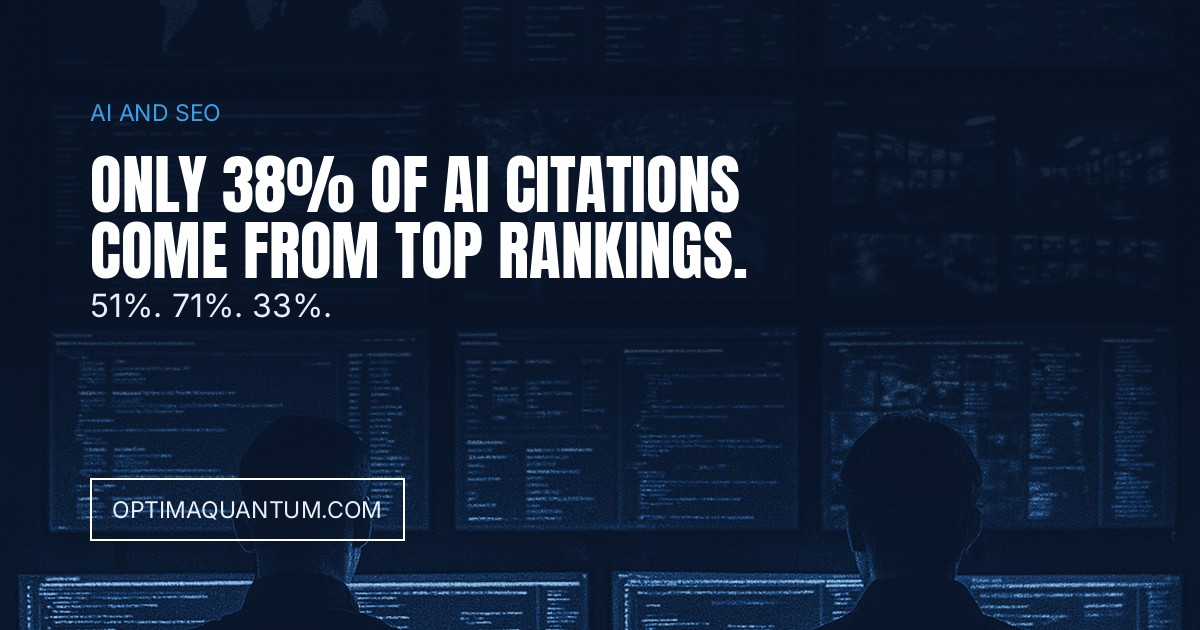
If your company already ranks well on Google but nobody mentions you when they ask ChatGPT, Gemini, or Copilot, the problem isn’t your SEO: it’s that those systems no longer cite what the search engine rewards. In March 2026, Ahrefs analyzed 863,000 searches and 4 million Google AI Overview citations and found that only 38% of the cited pages still came from the classic top-10 results, down from 76% in July 2025. In under a year, half of the link between “ranking well” and “getting cited” broke.
And while that’s happening on the search side, the buyer itself is moving. G2 surveyed 1,076 B2B purchase decision-makers in March 2026 for its The Answer Economy report and found that 51% now start their research in an AI chatbot more often than in Google, and 71% rely on one somewhere in the process. That’s not a footnote: 69% of those buyers ended up choosing a different vendor than they originally planned because the chatbot surfaced new information, and 33% bought from a company they had never heard of before AI suggested it.
Why your page can rank #3 on Google and still not show up in the AI answer
Google Search and a generative AI system aren’t answering the same question. Google ranks pages that answer the query as written. A chatbot, or Google’s own AI Overview, breaks the question into several sub-questions (Ahrefs calls it “query fan-out”) and builds the answer from fragments pulled from different sources, chosen because they answer each sub-question precisely, not because they win the ranking for the original query. That’s why a page that has held the #1 spot on Google for “cloud migration consulting Dubai” for years can be missing when someone asks ChatGPT to recommend a provider: the chatbot isn’t replicating the ranking, it’s building a new answer from scratch.
That doesn’t mean classic SEO stopped working (staying in the top 10 still helps: that 38% isn’t zero), just that it’s no longer enough by itself. A company that only optimizes for ranking is playing half the game.
What actually makes an AI cite you, according to the data
The same studies that show the ranking link collapsing also show what does influence whether an AI cites a source:
- Structured data and direct answers: a paragraph that answers the question in one clear sentence, with no detour, is easier to extract and cite than text that forces a reader through three paragraphs before reaching the fact.
- Third-party mentions, not just your own site: in G2’s survey, 45% of B2B buyers said review-site citations (G2 or similar) are the signal that gives them the most confidence inside an AI answer, ahead of what a brand says about itself.
- Verifiable content with a source: a figure or a regulation that can be checked against the original source carries more weight than a generic claim, because generative AI systems discount what they can’t verify against a clear reference.
- Freshness: a page that gets reviewed and corrected over time has better odds of staying cited than one frozen at its publish date.
- Decision acceleration: 80% of buyers in G2’s survey said the AI chatbot sped up their purchase decision. If your content isn’t ready to be cited in that moment, the decision speeds up without you in it.
An illustrative example
Picture two Dubai-based tech consultancies offering the same cloud migration service. The first has a 2,000-word article that ranks well on Google, but the price, the typical timeline, and the prerequisites are scattered across several narrative paragraphs. The second has a short section with a direct answer to “how long does a cloud migration take for an SMB?” and links its source (a published case, an industry standard). When a buyer asks a chatbot to compare cloud migration providers in the region, it’s far easier for the system to extract and cite the second company’s answer, even though the first still ranks higher on Google. The difference isn’t the underlying content quality: it’s whether the answer is ready to be quoted as-is, or has to be reconstructed first.
What your company can do this week
- Check your top 5 traffic pages and see if the answer to the main question sits in one clear sentence in the first paragraph, not buried further down.
- Add the exact source (standard, study, official figure) behind every data point you publish: an unsourced claim is the first thing an AI discards.
- Check whether your company has a presence on review sites in your industry: per G2, that’s the trust signal that carries the most weight inside an AI answer.
- Date the last review of content you want to keep getting cited, and actually review it, not just change the date.
- Ask ChatGPT, Gemini, or Copilot directly whether they know your company and what they say about it: it’s the cheapest way to measure where you stand today.
Getting a company’s digital presence ready to be found by both Google and generative AI systems — not just one of the two — is exactly the kind of work we do through our AI & automation services and digital transformation consulting: understanding, data point by data point, how a real buyer finds you today, and arranging the company’s content and systems so that answer includes you. If you want a diagnosis of how AI is citing you (or not) right now, you can contact us.
Understanding what an AI agent is and how it decides also helps explain why this is only going to matter more: more and more of these queries aren’t run by a person at a keyboard, but by an automated assistant researching vendors on a buyer’s behalf. If your company already uses AI to produce content, it’s worth revisiting how to actually optimize that content for SEO, because the keywords that win on Google aren’t necessarily the ones that win a generated answer.
Frequently asked questions
Is traditional SEO still worth investing in if AI decides what gets cited? Yes: 38% of AI Overview citations still come from Google’s top 10, so classic ranking still helps. But it’s no longer the only variable, and treating it as if it were leaves out the remaining 62% of the chances of getting cited.
How do I know if ChatGPT or AI Overviews already mention me? There isn’t an official analytics tool for this yet (neither Google Search Console nor any public dashboard measures it precisely). The practical approach is to ask the chatbot directly about your industry, your service, and your competitors, and note who comes up.
Do I need to rebuild my whole website for this? No. What changes first isn’t the design, it’s how the answer is written inside the content: direct, verifiable, and sourced. It’s content and structure work, not a redesign.
What does this have to do with the AI agents my customers already use? That the query a person used to type by hand is increasingly run by an automated assistant researching vendors on their behalf. If that agent can’t find a clear, verifiable answer in your content, it simply moves on to the next source.
Why should a small or mid-sized company worry about this now? Because 33% of the B2B buyers in G2’s survey already bought from a vendor they’d never heard of before a chatbot suggested it. That’s, literally, the door that opens for a company that isn’t on a buyer’s radar through the traditional route today.
Get our new articles by email
One email per article. Unsubscribe anytime.