
Contents
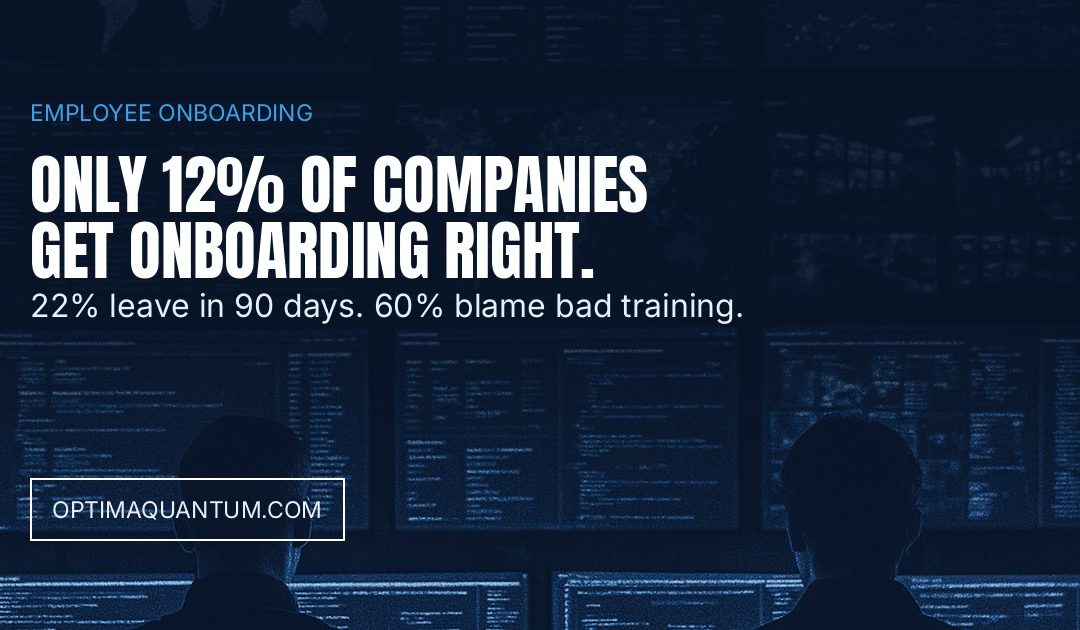
Only 12% of employees strongly agree that their organization does a great job onboarding new employees (Gallup). The other 88% live through an onboarding experience they wouldn’t call good. And the cost of that failure isn’t just a rough first day: 22% of new hires quit within their first 90 days, and 60% of those who leave say it was because of disorganized or missing training (Insight Global, 2025 Employee Sentiment Report). The same company that spent weeks hiring someone loses them before it ever recoups the cost of finding them.
The problem isn’t hiring. It’s what happens after
According to the same Insight Global study, 4 out of 5 employees would stay longer in a role if onboarding were better, and workers themselves say it takes 6 to 7 months to feel comfortable in a new job. That’s the real margin: people don’t leave over salary or the role itself — they leave over the first few badly managed months.
Starting that process over isn’t cheap, either. SHRM puts the average cost per non-executive hire in the US at $5,475, against a median of just $1,200 (SHRM, 2025 Benchmarking Report, a survey of 2,371 members between January and March 2025). That gap between the average and the median says it all: most hires are cheap, but a small number — the ones handled badly, with manual, repeated processes, or the ones who end up leaving and have to be replaced from scratch — drag the average way up.
What actually breaks onboarding
This isn’t a willingness problem: HR teams want it to work. It’s a load problem. A new hire’s first week almost always involves, mostly by hand: collecting and verifying documentation (contract, ID, bank details, confidentiality clauses), provisioning accounts and access in every system they’ll use, scheduling and chasing training sessions across different teams, and answering the same fifteen policy questions already answered for every other person who started this year. When one HR person has to do this for five or ten new hires at once, something gives — usually the follow-through during weeks 2 through 8, which is exactly the window Insight Global says decides whether someone stays.
Where AI actually fits (and where it doesn’t)
AI doesn’t fix company culture, and it doesn’t replace the manager who sits down with a new hire to explain how the work actually gets done — that stays, and should stay, human. What it can take off the manual checklist are the repetitive tasks eating the time that should go to the human part:
- Collecting and verifying documentation automatically, instead of chasing a missing contract or ID over email: the same technology we’ve already covered for AI document processing in a business applies just as well to a new-hire file as it does to an invoice.
- Provisioning access with the right permissions from day one, not a generic template that grants more access than the role needs: the same least-privilege standard we already require for AI agents inside a company applies to a new employee account too.
- Answering the same first-week questions at any hour, on the channel people already use, instead of HR repeating the same answer for the tenth time: it’s the same use case already covered by a well-designed WhatsApp AI agent, applied to onboarding instead of sales.
- Scheduling and chasing the first weeks of training without depending on someone remembering to resend an email: the same principle already working in AI appointment reminders.
This isn’t about automating the entire onboarding experience so a new hire never talks to anyone: it’s about freeing up the hours that go into paperwork today so the manager can spend them on the thing that actually decides whether someone stays, according to Insight Global’s own data — a relationship with their manager and a team culture that’s visible from day one.
What to do this week
- Ask HR how many hours it actually spends on each onboarding during the first four weeks, not just day one: that’s usually where the real gap is.
- Look at how many questions HR gets from new hires that are literally the same, hire after hire: that block is the first thing you can automate without touching anything human.
- Check what access a new account gets by default today: if it’s “the same template as always,” it’s probably granting more access than that specific role needs.
- Ask the last five people who joined what was hardest to figure out in their first month: the same answer usually comes up, and that’s the one to fix first.
How we help
At Optima Quantum, we don’t sell “digitize your onboarding” as a closed box: as part of our AI and automation services, we first review which part of your onboarding process is repeatable paperwork (and can be automated safely) and which part is a human relationship (and shouldn’t be touched), then integrate it with the systems you already use. If your company hires regularly and every onboarding still depends on one person remembering everything, contact us and we’ll review it together.
Frequently Asked Questions
What percentage of employees think their company onboards well? Only 12%, according to Gallup. The other 88% wouldn’t rate their own onboarding as good.
How many people leave within the first 90 days because of bad onboarding? 22% of new hires leave within the first 90 days, and 60% of those departures are attributed to disorganized or insufficient training, according to Insight Global.
Is it worth automating onboarding if we only hire a few people a year? It depends on volume: if you hire one or two people a year, probably not. If you hire regularly, the cost of repeating the same paperwork and the same questions every time usually outweighs the cost of automating the repeatable part.
Does AI replace the manager who welcomes the new hire? No, and it shouldn’t try to. According to Insight Global’s own research, what makes someone stay is their relationship with their team and manager from day one; AI only clears away the paperwork that’s currently eating into the time available for that relationship.
Get our new articles by email
One email per article. Unsubscribe anytime.