
Contents
An AI appointment reminder system is one that doesn’t just send the warning — it also listens to the answer. If your business runs on a booked calendar — a clinic, a salon, a repair shop, an advisory practice — every empty slot is money that never came in. The question isn’t whether you send reminders. It’s whether anyone can answer them without you picking up the phone.
In August 2026, the US Medical Group Management Association (MGMA) asked 190 medical groups how their year was going on no-shows. 32% said worse than 2025. Only 10% said better. Most of those groups already had automated reminders running before the survey. The problem isn’t missing alerts.
What an AI reminder system actually is (and isn’t)
An AI reminder isn’t a text message with a template and a date swapped in. That’s been around for years, and it’s what most businesses already run — with results that have stopped improving.
The real difference is what happens after it’s sent. Can the customer reply “can’t make it, can you move me to Thursday?” and have someone — or something — understand it and fix it on the spot? Or does the message just get read, with the only way to change the booking being a call during office hours and a wait?
A real AI system does three things a plain text doesn’t: it understands a reply in natural language, over WhatsApp or voice; it checks the actual calendar to offer a real alternative; and it confirms or reschedules without anyone on your team having to step in. If your “AI reminder” only changes the wording of the text, it isn’t that.
What nobody tells you: the problem isn’t the alert, it’s the reply
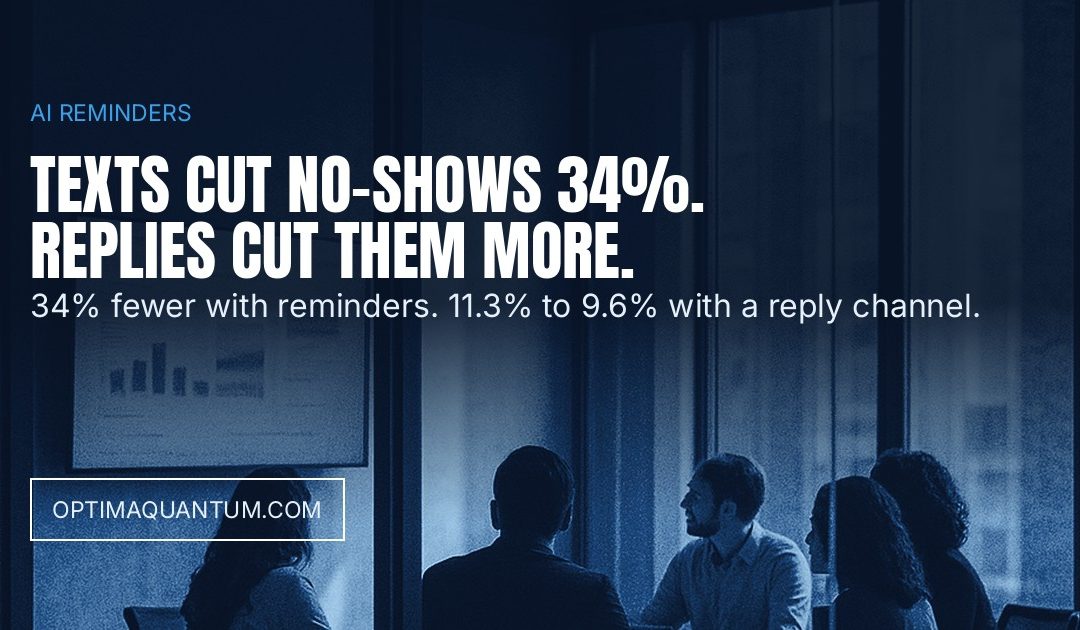
This is the number that explains why businesses with reminders are still losing bookings. A systematic review of hospital reminder studies (SMS and phone calls, indexed by the US National Library of Medicine) found that automated reminders cut no-shows by roughly 34% on average compared with sending nothing. That’s a real gain. But it’s only the first step.
The second step was measured in a Penn Medicine trial published in NEJM Catalyst in 2024, covering nearly 60,000 high-risk patients. Adding an automated call the patient could actually respond to — to confirm, cancel, or reschedule — on top of the text message they already received, cut the no-show rate from 11.3% to 9.6%. It wasn’t the extra alert that moved the number. It was that the call could resolve something right then, without a human calling back.
Most businesses stay on the first step forever. They send the message, cross their fingers, and if the customer doesn’t reply, that slot is lost exactly the way it was before reminders existed. The jump that actually changes the number isn’t sending the alert — it’s making sure the reply doesn’t depend on someone at the business being free to handle it.
What a real system has to be able to do
- Understand a free-form reply, not just a “Yes/No” button. A customer who writes “can we do an hour later?” needs a real alternative, not an error message.
- Check the live calendar, to offer slots that actually exist, not a fixed list someone had to program by hand.
- Work on the channel the customer already uses: WhatsApp for those who prefer to type, a voice call for those who prefer to talk or for last-minute alerts.
- Hand off to a person when it matters: a cancellation tied to a medical emergency, or a complaint, isn’t something any system should resolve — it needs to reach a person, with the context already captured.
- Leave a record: what was confirmed, what was cancelled, what was rescheduled and when, so you can actually measure whether no-shows are going down.
Where this fits in your business
If your calendar has more than a handful of bookings a day, and every no-show costs you a slot you can’t recover that week, this isn’t a technology indulgence — it’s the same kind of loss MGMA already measures in clinics, carried over to any business that runs on appointments. Aesthetic clinics, repair shops, dental practices, advisory firms with scheduled meetings, academies with booked classes: all of them lose the same thing when a reserved hour sits empty because the cancellation came too late to fill it with someone else.
You don’t need to replace whoever runs the calendar. You need to take the repetitive part off their plate — reminding, confirming, rescheduling the simple cases — so they’re left with what actually needs a person: an exception, a complaint, a sale that depends on handling the call well.
Our approach: SmartCalls and WhatsIA
At Optima Quantum we don’t sell a text template with a new name on it. We put in place a system that connects your real calendar to two channels that work together: AI voice agents that call or answer to confirm and reschedule appointments, and WhatsApp AI for customers who’d rather text it out. Both read and write to your actual calendar, not a list of slots someone updates by hand, and both hand off to a person on your team exactly when that call needs human judgment.
The goal isn’t sending more alerts. It’s making sure every alert ends in a confirmed booking, a reschedule, or a slot released in time for someone else — not an empty hour you discover the same day.
Frequently asked questions
How much do automated reminders actually cut no-shows? A systematic review of clinical studies indexed by the US National Library of Medicine points to an average reduction of around 34% compared with sending no reminder at all. That’s the starting point, not the ceiling.
Is WhatsApp or a voice call better for confirming an appointment? It depends on the customer and the urgency. The Penn Medicine trial (NEJM Catalyst, 2024) found that adding a call patients could respond to, on top of a text message, cut no-shows from 11.3% to 9.6% across nearly 60,000 patients. Combining both channels moves the number more than betting on just one.
Does this replace the person running the calendar? No. It handles the repetitive part — reminding, confirming, moving a booking to another open slot — so the person is left with the exceptions: an emergency, a complaint, a negotiation.
Which businesses actually need this? Any business with a booking calendar where a no-show leaves a slot that can’t be filled afterward: clinics, salons, repair shops, advisory firms, academies with scheduled classes.
Do we have to change the WhatsApp number or phone line customers already use? Not necessarily — the system connects to the channel your customer already knows, with the only difference being that now their booking actually gets handled on the spot.
Next step
If a slot goes unfilled most weeks because the cancellation came too late, get in touch and we’ll look at your real calendar: how many bookings, how many no-shows, and which channel your customers already use. From there we decide whether what you need is voice, WhatsApp, or both.
Get our new articles by email
One email per article. Unsubscribe anytime.