
Contents
If your company needs custom software, a website that actually converts, or an internal system that has outgrown its spreadsheet, the question is no longer “do developers use AI?” That one is already settled: almost all of them do. The question that actually matters for your business is different: who is steering that AI, and what happens when it gets something wrong that you can’t afford to get wrong?
The real 2026 numbers, not the marketing pitch
The Stack Overflow Developer Survey is the largest, least self-interested source on this topic: no AI vendor funds it, and the respondents are the developers themselves, not a sales team.
The numbers for 2026:
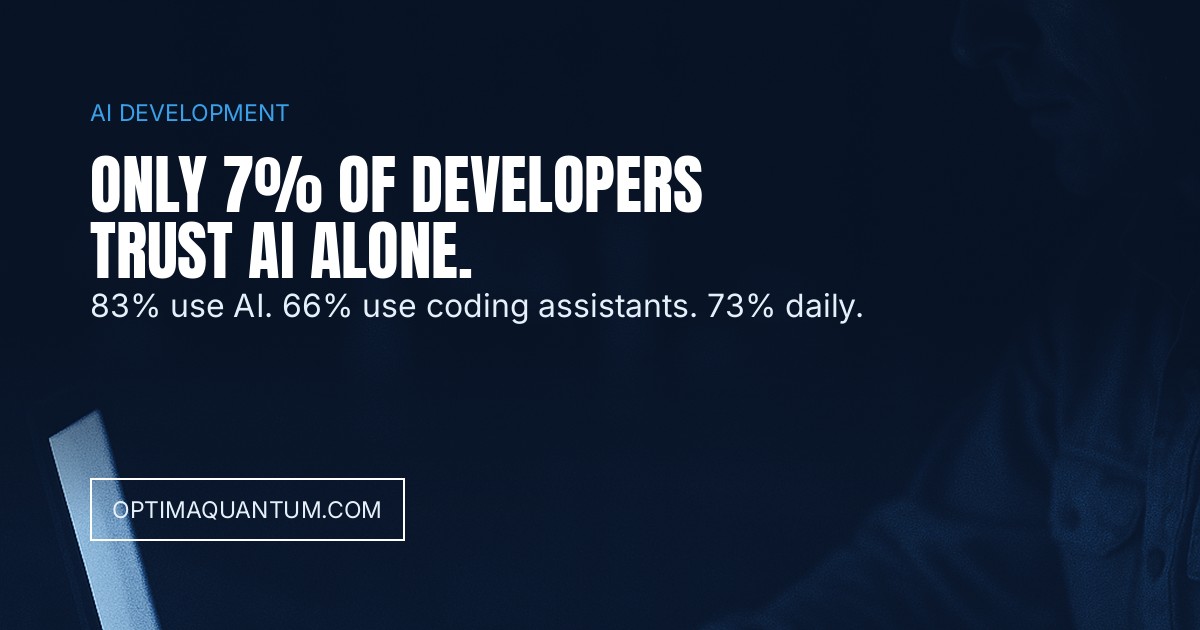
- 83% use at least one AI tool in their daily work.
- 66% use coding assistants (AI that writes or suggests lines of code) and 63% use general-purpose chat tools like ChatGPT to work through problems.
- Among those who use coding assistants, 73% use them every single day — it is no longer a pilot, it is the normal workflow.
- Only 26% use autonomous agents or workflows (AI that completes full tasks without step-by-step supervision) — most developers are still reviewing every line.
Source: Stack Overflow Developer Survey 2026 — AI data.
The gap nobody puts in the pitch deck: everywhere, but not trusted
Here is the number that actually explains why a senior engineer still has to sit behind the keyboard, not just a tool subscription:
- Only 7% of developers trust AI with important decisions.
- Only 16% say AI handles complex tasks well; 39% call it “good, but not great,” and the rest simply do not trust it.
- 48% only trust the output when they can easily verify it — in other words, when someone with real technical judgment reviews it before it reaches production.
Same source: Stack Overflow Developer Survey 2026.
What the “build your app with AI in a weekend” ads never say out loud: AI does not replace software engineering, it multiplies it when a senior engineer is steering it, and it becomes a liability when nobody is. A company that buys “AI development” without engineering behind it is buying speed without quality control — and that bill comes due later, as production bugs, broken security, or a system nobody understands six months in.
What this actually means if your company needs software
If you’re weighing digitizing a process, replacing a tool your business has outgrown, or building a product of your own, here is what genuinely changes when AI is used well:
- First working prototypes arrive faster. What used to take weeks to see running can now take days — as long as the coding assistant is driven by someone who can read what it generates, not just copy it.
- Repetitive work gets cheaper. Data migrations, test writing, documenting existing code: these are exactly the tasks where AI performs best and the risk of a serious mistake is lowest.
- Human review doesn’t disappear, it concentrates where it matters. Security, architecture, and business-critical decisions still belong to a senior engineer — precisely where developers’ own trust in AI (7%, 16%) is lowest.
The risk most vendors won’t tell you about: security
This is where our other line of business, cybersecurity, enters the conversation directly. Veracode’s 2026 GenAI Code Security Report — one of the world’s reference firms in application security, not an opinion blog — tested how dozens of AI models write code against real OWASP Top 10 vulnerabilities, and found this:
- Roughly 44% of AI code-generation tasks introduced a real security vulnerability. The average security pass rate sits at 56%, barely changed from the prior year: AI is not improving security at the same pace it’s improving speed.
- Performance varies enormously by flaw type: models handle SQL injection well (83% pass rate) and weak cryptographic algorithms well (87%), but fail systematically against cross-site scripting (only 15% pass rate) and log injection (12%).
- The report itself notes that AI now authors roughly half of all code committed to production at companies that use it — meaning this isn’t a marginal problem, it’s half of what your vendor is actually shipping you.
Source: Veracode — 2026 GenAI Code Security Report.
This doesn’t mean running away from AI in software development. It means that if your vendor isn’t actively reviewing the security of what the AI generates, you’re flipping a coin on every release. That’s why at Optima Quantum the same team that builds the software also runs security audits and penetration testing: review isn’t an optional add-on sold separately, it’s part of how the work is delivered.
How we actually do this at Optima Quantum
We don’t sell “AI that builds your company’s software by itself.” We work as software engineers have since 1999: a call to understand the problem and the real numbers, a proposal with scope and price fixed before we start (no open-ended hourly invoice), weekly deliveries of working software — not slide decks — and, at the end, you choose: we run it with permanent monitoring, or we hand it over fully documented and it’s yours. AI goes where it genuinely speeds things up (prototypes, migrations, testing, documentation); the call on what gets automated and what gets reviewed by hand belongs to an engineer, not an assistant.
Frequently asked questions
Can AI build a complete application with nobody reviewing it? It can generate large chunks of working code, especially for repetitive or well-solved problems. But according to the developers who use it daily, only 16% trust it to handle complex tasks well without supervision — which is why every delivery goes through engineering review, not just AI output.
Does using AI for software development make a project cheaper? It cuts the cost of repetitive work (testing, migrations, documentation, first prototypes). It doesn’t cut or replace architecture design, security, or the decisions that depend on actually understanding your business — that’s still the same senior engineering work it always was.
Is AI-generated code secure? Not by default. Veracode’s 2026 report found that roughly 44% of AI code-generation tasks introduced a real vulnerability, with especially weak results on cross-site scripting and log injection. That’s why every AI-assisted delivery needs a security review, not just a functional one.
What if I already have a legacy system and want to modernize it with AI’s help? This is one of the cases where it pays off most: analyzing old code, documenting it, and migrating it are tasks AI speeds up considerably with supervision. We cover this in depth in our digital transformation service.
Do I need to understand technology to ask for AI-assisted development done right? No. The first call is about understanding your problem and your numbers, not testing your tech knowledge. Scope and price are fixed before we start, with no surprises later.
Where does this fit with what Optima Quantum already offers? With our AI automation services and the AI agents we already use in real projects, and alongside our work on AI document processing: AI-assisted software development is the same engineering discipline, with one more tool in the box, directed by people who know when to use it and when not to.
Have a system that’s outgrown itself, or a project you want to see working soon? Tell us the problem and we’ll tell you if we can solve it, and how long it will take.
Get our new articles by email
One email per article. Unsubscribe anytime.