
Contents
A study by Optima Quantum covering 27,291 small and medium-sized Spanish business websites, audited between August and September 2026, found that nearly half have no analytics installed at all (no Google Analytics, no Tag Manager): they have no idea how many people visit their site, where those visitors come from, or what they do once they arrive. 45% of the sites stack three or more basic technical problems at once. Only 9% have none of the issues we measured.
The study in four numbers:
- 44% of the websites track none of their own traffic.
- 32% have no meta description: Google is left to pick whatever text it wants to show under the title in search results.
- 30% have no H1 headline on the homepage, the first signal Google uses to understand what the page is about.
- 45% stack 3 or more problems at the same time; only 9% have none.
Why we are publishing this
Optima Quantum is a cybersecurity, artificial intelligence and software development company. As part of an outreach campaign, we have been auditing, free of charge, thousands of Spanish small-business websites discovered through our own mapping of local businesses, notifying each business of the issues found on its own site. The aggregated data from that campaign — never the detail of any single company — is what we publish here, because it shows a pattern that doesn’t show up in intent surveys (“do you have a website?”) but in real execution: thousands of businesses with a website already built, carrying basic, free-to-fix problems.
Methodology
- Universe: 27,291 unique Spanish business domains, found through our own business mapping (shops, clinics, garages, restaurants, real-estate agencies, professional offices…), with a declared website reachable over HTTP (status 200) at the time of the audit.
- Period: audits run between August and September 2026.
- What was measured, automatically and objectively, for each site: presence of Google Analytics/Tag Manager and whether it actually fires, server response time, presence of an H1 on the homepage, meta description, sitemap declared in robots.txt,
<title>length as Google truncates it, presence of robots.txt, a visible way to make contact from the homepage (phone, email or form), broken images, and critical errors (for example, a homepage accidentally markednoindexwithout the owner knowing). - An honest limitation: this is not a random sample of “all Spanish SMEs,” but of businesses findable through our own mapping, with a declared website. We make no claim of national statistical representativeness; what it does offer, by sheer size (27,291 real websites), is one of the largest public snapshots of the real technical state of the Spanish small-business web.
- No audited company is ever identified. Every figure in this study is an aggregate; no domain, name or data point belonging to a specific company is named or shared with anyone.
What’s broken, ranked
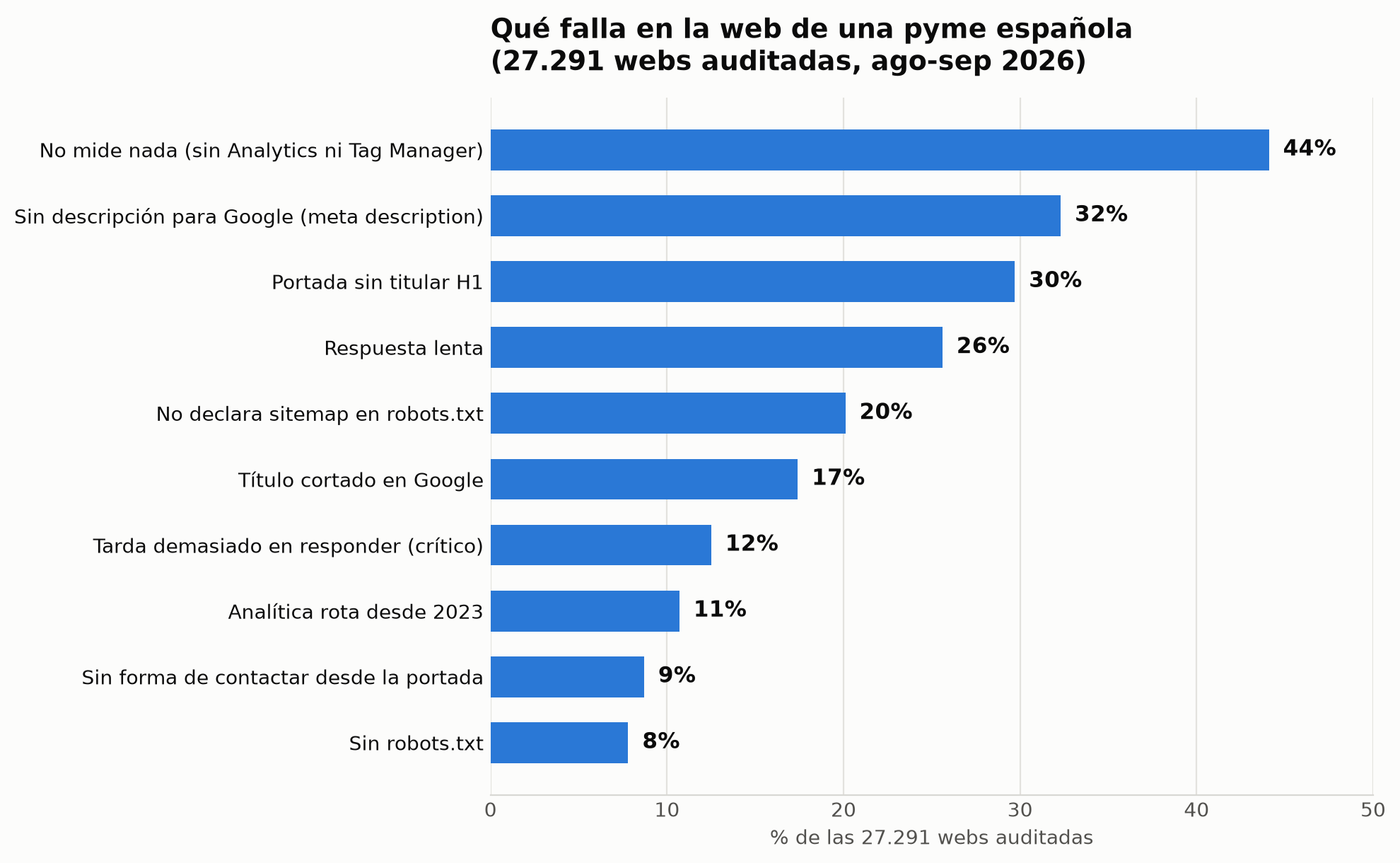
The most common failure isn’t cosmetic: 44% of the audited sites have no measurement system installed at all. That means the business owner has no idea whether the website brings in customers, how many, or which page of their own catalog performs best — they are making decisions about their own shop blind. Close behind is basic SEO: a third (32%) have no meta description, and almost a third (30%) don’t even have an H1 on the homepage, leaving Google to guess what the business actually does.
26% respond slowly enough to notice, and 12% are slow enough to brush against the point where a visitor gives up and leaves for a competitor. 11% have analytics installed that stopped working back in 2023 — and nobody noticed: three years of staring at a dashboard collecting no new data.
How many problems each website carries
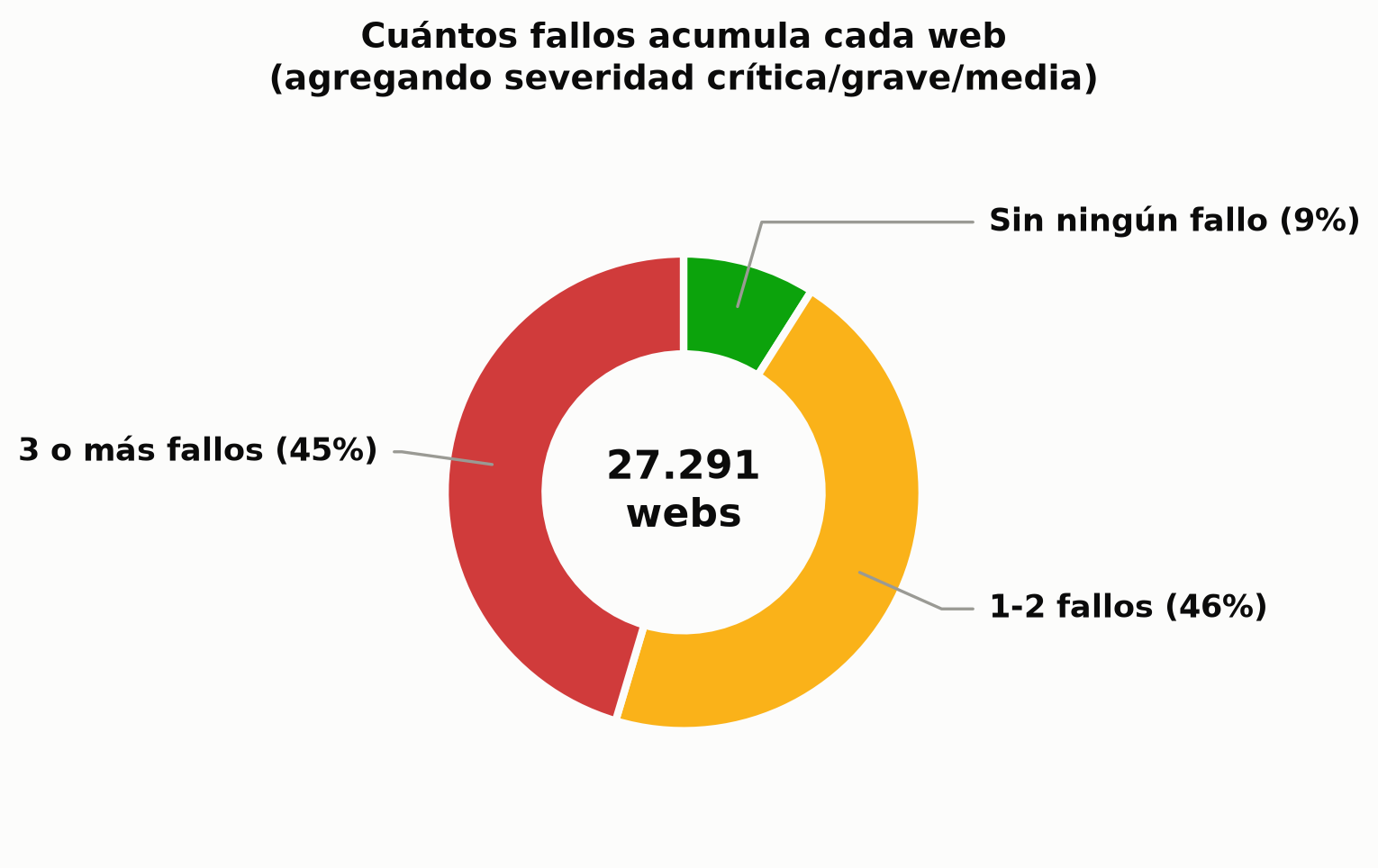
These aren’t isolated issues: 45% of the audited websites stack three or more of the problems we measured at the same time, and another 46% carry one or two. Only 9% of the Spanish SME websites we audited have none of the issues we looked for. In other words: 9 out of 10 small-business websites in Spain carry at least one basic, free-to-fix technical problem.
What official bodies already said — and what our data adds
This pattern doesn’t exist in a vacuum. Two official sources frame it:
- ONTSI (Spain’s National Observatory of Technology and Society, under Red.es), in its Digital Intensity Indicators of SMEs, 2025 edition (2024 data), puts basic digitalization among Spanish SMEs at 74.2%, but only 5.6% reach a “very high” digital intensity level. There is entry-level digitalization, but very little depth.
- INCIBE, Spain’s national cybersecurity institute, in its 2025 Cybersecurity Balance, recorded 122,223 cybersecurity incidents in Spain in 2025, up 26% from 2024, and detected 237,028 vulnerable systems (up 29%). INCIBE does not break that figure down by company size, so we don’t use it to claim “how much of this hits SMEs specifically” — we cite it to show the scale of the general risk these businesses operate within.
What our 27,291 cases add is the execution-level picture: official bodies measure intent and technology adoption (“do you have a website, do you sell online, do you use the cloud?”); we looked at the website as already built, exactly as a visitor or Google sees it today, and found that a large share of that “basic digitalization” still has elementary gaps left open.
What a small business should check today
None of these five points require a large budget or weeks of work:
1. Check whether it actually tracks anything. Having “installed” Google Analytics years ago isn’t enough — verify the code is still firing on today’s live site. 2. Put a clear H1 on the homepage stating in one sentence what the business does — it’s the first thing both visitors and Google read. 3. Write a real meta description for the homepage and key pages, instead of letting Google truncate a random paragraph. 4. Check load time from mobile, not just from an office computer on fiber. 5. Leave a visible contact channel on the homepage (phone, email or form) without making the visitor search for it.
Anyone who wants a free review of their own website against this same checklist can request one at optimaquantum.com/cybersecurity/; anyone who already knows they need help fixing it can reach our consulting team at optimaquantum.com/it-consulting/.
Transparency note
This study only publishes aggregated data. No audited company is named, identified or described individually; any examples in this text are illustrative, not named real cases. The full methodology is available to any journalist or researcher who wants to verify it — request it through the contact channel below.
For journalists
- Full figures and chart, ready to cite: the top 10 issues with their exact percentages are in the bar chart above. Sample size: 27,291 websites. Period: Aug-Sep 2026.
- Free to use: any figure in this study may be cited, linked or reproduced, crediting “Optima Quantum” with a link to this page.
- Statements: Optima Quantum is available to expand on any figure in this study or comment on the broader context of Spanish SME cybersecurity and digitalization. Contact: optimaquantum.com/contact/ or info@optimaquantum.com.
Get our new articles by email
One email per article. Unsubscribe anytime.