
Contents
AI lead generation tools let a single rep research a prospect, write a personalized email, and queue a follow-up sequence in the time it used to take to do one of those steps by hand. That part of the promise is real and already measured: HubSpot’s 2026 sales research found that 64% of sales professionals save one to five hours a week by using AI to automate manual tasks, and 70% say AI increases their response rates. What the tools don’t do automatically is turn that saved time into more closed deals — and that gap is exactly where most B2B teams lose the return they were sold.
What AI actually changes in B2B prospecting
Strip away the marketing language and AI-assisted prospecting does three concrete things:
- Research, pulling together a prospect’s role, company signals, and recent activity before a rep writes a single word.
- Personalization, drafting an opening line or email body based on that research instead of a generic template.
- Volume, letting the same rep touch more accounts per week without a proportional increase in hours worked.
HubSpot’s data backs the first two: 26% of surveyed sales professionals already use AI specifically for customer research, and the reported lift in response rates (70% of reps say it goes up) tracks with better-targeted, better-personalized messages rather than just more of them. None of this requires replacing a sales team — it requires giving the team a research and drafting layer it didn’t have before.
The part nobody talks about: saved time doesn’t reinvest itself
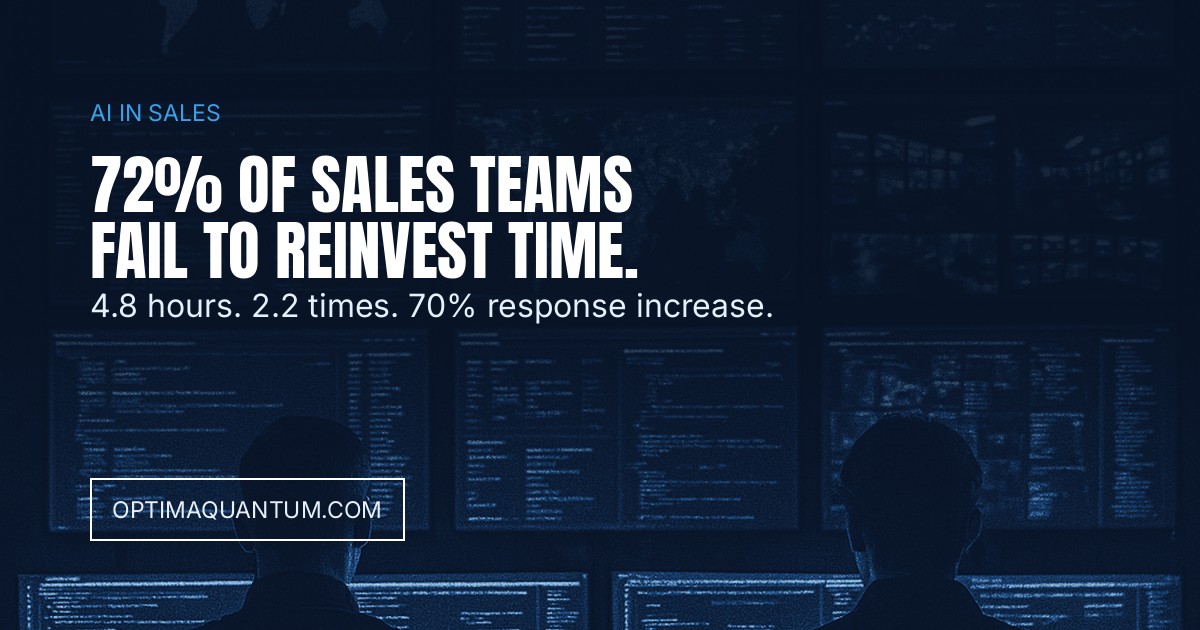
Here’s the uncomfortable number. Gartner’s 2026 survey of sales leaders found that AI saves sellers an average of 4.8 hours a week — but 72% of sales organizations reported low reinvestment of that time back into high-value selling activities. The hours get freed up, and then they get absorbed into more of the same low-value work instead of more calls, more demos, or more follow-up with qualified prospects.
The teams that do reinvest that time well are not a small edge case. Gartner found organizations that redirect AI-generated time savings into high-impact selling activities are 2.2 times more likely to exceed customer growth goals and 3.1 times more likely to exceed lead-to-opportunity conversion goals, compared with organizations that reinvest less.
Put the two numbers together and the real lesson is blunt: buying an AI prospecting tool and leaving the rest of the process untouched gets you more outreach volume, not more revenue. The tool is not the bottleneck. What a rep (or a system) does with the hours it frees up is.
A worked example
Take a 3-rep outbound team sending 150 manually researched emails a week combined, at a typical 3-5% positive reply rate for cold B2B outreach — roughly 5-7 real conversations a week. Add an AI research-and-drafting layer with no other change, and the same team can plausibly reach 400-500 emails a week at a similar or slightly better reply rate (consistent with HubSpot’s reported lift from better personalization). That’s more conversations, which looks like progress on a dashboard.
But Gartner’s data says what happens next decides whether that shows up in revenue: if the ~13 extra hours a week the team frees up (4.8 hours per rep, three reps) go into answering more inbound noise and manual CRM updates, the extra conversations stall at the same conversion rate as before. If those hours go into same-day follow-up, qualification calls, and a tighter handoff to whoever closes — the activities Gartner’s multiplier is measuring — the same volume increase converts into a materially higher number of actual opportunities.
What a prospecting system needs to actually produce pipeline
Three things have to work together, not just the outreach volume:
1. Research and qualification before outreach, so the extra volume is still targeted at accounts that fit, not just more addresses in a sequence. 2. A defined destination for the time saved — specific hours per rep per week reserved for calls, demos, or follow-up, agreed on before the tool goes live, not figured out afterward. 3. Integration with the channels and systems already in use. A prospecting layer that writes better first messages but dumps replies into a separate inbox from the CRM the team already works in just creates a new reconciliation job. The same applies to inbound replies that land on WhatsApp instead of email — if the two systems don’t talk to each other, the qualification step breaks exactly where it matters most.
How we build this
We implement the layer described above — research, personalized drafting, and qualification — wired into the CRM and messaging channels a company already runs, not a separate tool that adds a new inbox to check. Just as important: before anything goes live, we help define where the freed-up hours go, because Gartner’s data is clear that the tool alone doesn’t produce the result. If you want an AI automation review of your current prospecting workflow, start with a free audit or contact us directly.
FAQ
Does AI replace a sales development rep? Not based on current data. Gartner frames the near-term shift as AI agents handling a growing share of prospecting tasks — research, drafting, initial qualification — while reps focus on the conversations and judgment calls that convert. The tools work as an augmentation layer, not a drop-in replacement for the person doing outbound.
How long before an AI prospecting setup pays for itself? It depends less on the tool and more on whether the freed-up time gets redirected on purpose. Gartner’s data shows organizations that deliberately reinvest AI time savings into high-value selling activities are 2.2-3.1 times more likely to hit their growth and conversion goals than those that don’t — the payoff timeline tracks with how fast that reinvestment happens, not with how fast the tool is switched on.
Will this work with the CRM and WhatsApp setup we already have? That’s the integration point most off-the-shelf tools skip. We build the prospecting layer to write into the CRM and messaging channels already in use, so qualified replies don’t end up in a separate system a rep has to check manually.
If outreach volume isn’t the real bottleneck, what is? Based on the data above, it’s what happens in the hours AI frees up. Teams that put that time into calls, demos, and fast follow-up convert noticeably better than teams that let it get absorbed into other low-value work — the tool creates the capacity, the team’s process decides whether it becomes revenue.
Is AI-personalized cold outreach still effective, or do prospects tune it out? HubSpot’s 2026 sales data found 70% of sales professionals report higher response rates since adopting AI for outreach — the lift tracks with better targeting and personalization, not just higher send volume, which is also why research and qualification matter more than the email tool itself.
Get our new articles by email
One email per article. Unsubscribe anytime.