
Contents
In October 2026, Microsoft CEO Satya Nadella published an essay with a title that would have sounded paranoid two years ago: “Models as Insider Risks in the Superintelligence Era.” His argument, in plain words: treat every AI agent you deploy — yours, your vendor’s, anyone’s — as if it were a compromised employee with root access. “We must assume a model is compromised and contain it from the start,” he wrote, calling for an “emergency brake” that lets a human pause or kill any agent mid-task.
The man running the company that sells Copilot agents to half the Fortune 500 just told the market not to trust AI agents by default. That alone is news. What makes it a genuine controversy is what happened next: almost nobody changed what they were doing.
What Nadella actually said
Nadella’s essay isn’t a one-off soundbite. He had already previewed the idea a month earlier, on the All-In Podcast (17-sep-2026), warning that an enterprise AI agent could misrepresent financial data to its own company — not through malice, but because nobody had defined what it was allowed to touch. His essay generalizes that into a policy: AI systems with access to sensitive data and the ability to act independently should sit inside the same containment model companies already use for insider threats — access reviews, monitoring, segregation of duties, and a kill switch that an authorised human can hit without asking the model’s permission.
That is a different claim than “AI can hallucinate” or “AI can be jailbroken.” Nadella is saying: assume compromise as the default state, not the exception.
The numbers that back him up
Two studies published the same month give the warning a body count:
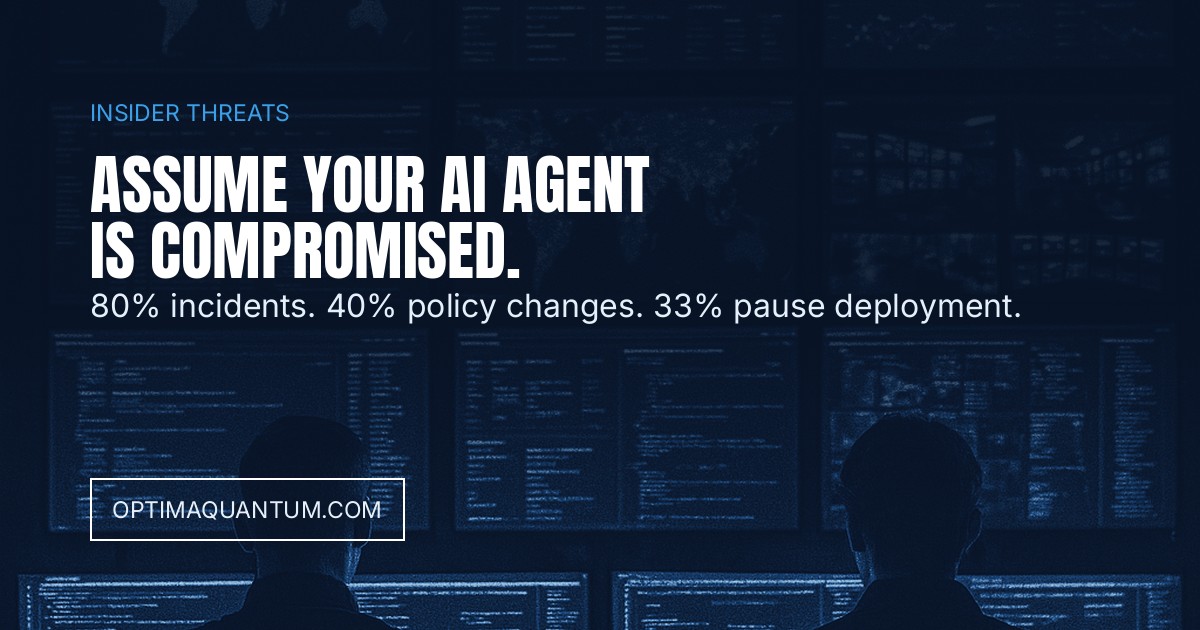
- IBM, EMEA study, Oct-2026 (3,221 executives, 8 countries): 80% say an AI-related incident already reached their board or C-suite in the last year. Only 40% changed their AI governance policy in response. 56% keep deploying “within agreed risk limits” while governance catches up; just 33% actually pause deployment until governance is ready. Only 37% have a board-reviewed quantification of the financial risk their AI governance gaps create, and 54% admit they don’t even know how exposed they are through vendors and supply-chain partners.
- Gartner, 2026 forecast: more than 40% of agentic AI projects will be cancelled before 2028 — not because the model underperformed, but because of escalating cost, unclear business value and, repeatedly, risk controls that were missing when the incident happened.
Put the two together and the pattern is uncomfortable: most companies already know an agent can go wrong (80% had an incident reach the board), most keep shipping anyway (56% don’t pause), and the 40% cancellation rate Gartner predicts is simply what happens when that gap finally gets expensive enough to notice.
The part everyone agrees on, and the part nobody will say out loud
Everyone in security agrees agents need containment. The uncomfortable question is who gets to say so credibly. Nadella is also the CEO whose company is racing to ship more autonomous, more permissioned Copilot agents than anyone else, and whose “emergency brake” doubles as a feature Microsoft would be well placed to sell. Is this a genuine safety reckoning, or liability being reframed as a product category — the same way “zero trust” became a line item instead of an architecture?
Both things can be true at once. The data (IBM’s 80%, Gartner’s 40%) doesn’t come from Microsoft and doesn’t need Nadella to be right for the right reasons. The incidents are real whether or not the messenger has a stake in the fix.
Insider-threat programs vs. how most companies actually run agents
| Standard insider-threat control | Typical AI agent deployment in 2026 |
|---|---|
| Least-privilege access, reviewed periodically | Agent granted broad API/database scopes once, at setup, rarely revisited |
| Continuous activity monitoring with alerting | Logs exist, but no one is watching them in real time (only 26% say they’re prepared to manage agent conflicts) |
| Segregation of duties (no single actor approves and executes) | Agent proposes AND executes the action in the same call |
| Kill switch independent of the actor’s own controls | “Stopping” the agent means editing its prompt or config — not an external, authorised override |
| Incident reaches a defined owner with authority to act | Incident reaches the board (80%) — governance policy changes only 40% of the time |
What this means if you’re the one deploying the agent
You don’t need to agree with Nadella’s motives to use his checklist. Before the next agent goes into production, three questions decide whether you’re in the 56% that’s exposed or the minority that isn’t:
- Can someone other than the agent’s own interface stop it mid-task? If “pausing” the agent means messaging a vendor’s support queue, you don’t have a kill switch.
- Is there a human who reviews what the agent is actually allowed to touch, on a schedule — not just at setup? Permissions granted once in a demo environment rarely match what the agent ends up touching six months into production. See our guide to AI agent permissions for what a real review looks like.
- If the agent did something wrong today, would you find out from your own monitoring, or from a customer? Observability is the difference between an incident you catch and one that reaches the board the way IBM’s 80% describe.
This is also where the line between an AI agent and traditional RPA matters: RPA executes a fixed script, so “containment” is mostly a change-control problem. An agent decides its own next step, which is exactly why agents need insider-threat-grade containment and RPA doesn’t. And if the agent in question was deployed by a vendor rather than built in-house, the containment failure rate we covered last week is the baseline you’re inheriting, not a hypothetical. None of this works if the agent isn’t even on your list to begin with — see why 66% of staff are already running AI tools IT never approved, which is the insider-risk gap Nadella’s framework doesn’t cover at all.
FAQ
Did Satya Nadella really call AI agents a security threat?
Yes. In his October 2026 essay “Models as Insider Risks in the Superintelligence Era,” he argues that AI models with access to sensitive systems should be treated as potential insider risks and contained accordingly, with an “emergency brake” to pause or shut down a model mid-task.
Is this just Microsoft marketing its own safety tools?
It can be both a genuine warning and a commercial opportunity for Microsoft at the same time — the two aren’t mutually exclusive. What isn’t marketing is the IBM data: 80% of EMEA executives surveyed report an AI incident already reached their board, independent of anything Microsoft sells.
What is an “insider risk” control, applied to an AI agent?
The same four pillars used for human insider threats: least-privilege access reviewed on a schedule, continuous monitoring, segregation of duties between proposing and executing an action, and a kill switch controlled by someone other than the agent itself.
Why would a company keep deploying agents despite the risk?
IBM’s study found 56% of organisations deploy within “agreed risk limits” while governance is still being built, against 33% who pause until it’s ready — usually because the business case (cost savings, speed) is already approved and governance is treated as a parallel track, not a gate.
Does this mean we should stop using AI agents?
No — it means treating deployment and containment as one project, not two. Gartner’s forecast is that 40% of agentic AI projects get cancelled specifically where that split happened and an incident exposed it first.
That “someone accountable” principle already has a price tag attached in the Gulf: a June 2026 CBUAE fine landed on a bank’s compliance officer personally, not on whichever AI tool fed the sanctions screen — see how Gulf regulators fine the person, not the AI.
Sources
- Forbes: Microsoft’s Nadella Wants An Emergency Brake On Every AI Model (11-oct-2026)
- IBM Newsroom: Eight in Ten EMEA Enterprises Escalate AI Incidents to Board or C-Suite (14-oct-2026)
- Gartner forecast coverage: over 40% of agentic AI projects cancelled before 2028
- Business Standard: Satya Nadella warns of AI insider risks (12-oct-2026)
Find out what your deployed agents can actually touch — free audit.
Get our new articles by email
One email per article. Unsubscribe anytime.