
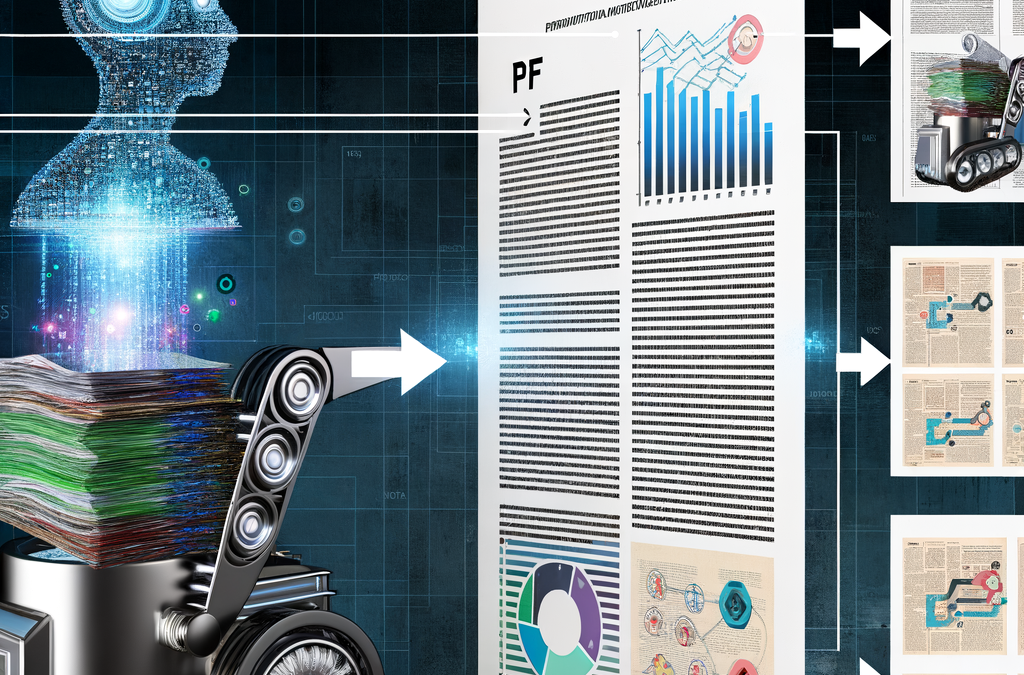
Artificial intelligence (AI) has revolutionized the way we interact with technology, providing solutions and optimizations across multiple sectors. In this article, we will explore how AI transforms the collection and processing of information, specifically the ability to interpret file formats such as PDF, despite the initial limitations in direct interaction with these documents.
AI in PDF Document Interpretation
PDF files are a standard format for presenting and exchanging documents. This format poses unique challenges for AI in terms of content interpretation and extraction due to its static and structured nature. Despite its complexity, artificial intelligence tools are rapidly advancing in their ability to break down and analyze this type of file.

Optical Character Recognition (OCR) technology is essential for this task. OCR algorithms have evolved significantly, enabling AI to identify and convert text from an image or scanned document into accessible digital data. This advancement facilitates indexing and searching within PDF documents, becoming a vital tool for companies and developers looking to enhance their document workflow.
Emerging Technologies for PDF File Processing
Beyond OCR, new technologies are constantly emerging, offering a more integrated approach to PDF document processing. Techniques in natural language processing (NLP) have enhanced AI’s ability to understand the context and central themes within documents. This enables artificial intelligence applications to extract information not only accurately but also with contextual relevance.
Moreover, the use of deep neural networks is revolutionizing this field. These networks are capable of detecting patterns and relationships within large amounts of data, transforming them into useful models for document interpretation. Tech companies and startups are investing in the development of such systems to enhance the understanding and manipulation of PDF files, opening up new possibilities for automated document handling.

Artificial intelligence is transforming how we interact with PDF documents, overcoming initial barriers through advancements such as OCR and NLP. These tools not only enhance the understanding and management of files but also boost efficiency across various sectors. Undoubtedly, we are witnessing only the beginning of the impact that AI will have in the documentary field.
How This Works in Practice
Implementing AI-driven solutions for PDF interpretation and processing requires a structured approach that involves several key steps and stakeholders. Initially, organizations need to identify specific use cases where AI can improve document handling, such as automating data extraction or enhancing search capabilities.
The first step is to assess the existing infrastructure and ensure that the necessary hardware and software are in place. This may include upgrading servers, installing AI frameworks, and integrating existing document management systems with new AI tools. Once the technical foundation is established, teams can begin the selection of appropriate AI tools, which often involves evaluating different OCR and NLP solutions based on their accuracy, scalability, and ease of integration.
Next, organizations must gather relevant training data. For OCR, this may involve compiling a diverse set of PDF documents to train the algorithms effectively. For NLP applications, annotated data sets that reflect the types of documents and contexts the AI will encounter are crucial. Involving domain experts in this process can enhance the quality of the training data.
Once the data is ready, the AI models can be trained and fine-tuned. This step often requires collaboration between data scientists and software developers to ensure that the models are optimized for the specific characteristics of the PDF documents being processed. Testing and validation are essential to ensure model accuracy before full deployment.
After successful testing, organizations can implement the AI systems into their workflows. This may involve training end-users on how to utilize the new tools effectively. Continuous monitoring and feedback loops are critical, as they allow for ongoing improvements and adaptations based on user experience and evolving document types.
In summary, the process involves a clear sequence of assessing needs, preparing infrastructure, selecting tools, gathering data, training models, and implementing solutions, all while ensuring that stakeholders from various departments are involved throughout the process.
What to Watch Out For
While the integration of AI in PDF processing presents numerous advantages, there are limitations and potential pitfalls that organizations should be aware of. One common mistake is underestimating the complexity of the documents. Not all PDFs are created equal; some may contain complex layouts, embedded fonts, or images that can hinder OCR accuracy. Organizations should evaluate the types of documents they frequently handle and prepare accordingly.
Another trade-off to consider is the balance between automation and human oversight. While AI can significantly speed up processes, complete reliance on AI without human validation can lead to errors, particularly in nuanced interpretations or contexts that require a deeper understanding. Organizations should implement checks and balances to ensure that critical decisions are not made solely based on AI outputs.
Additionally, there can be issues related to data privacy and compliance. When processing sensitive information, it is crucial to ensure that AI systems adhere to relevant regulations and standards. Failing to do so can result in legal repercussions and damage to an organization’s reputation.
Moreover, organizations should be prepared for the potential costs associated with implementing AI solutions. While AI can lead to long-term savings, the initial investment in technology, training, and ongoing maintenance can be substantial. It is essential to conduct a thorough cost-benefit analysis before proceeding.
Lastly, organizations should remain vigilant about the rapid pace of technological change. AI tools and techniques are continually evolving, and what works today may become outdated tomorrow. Regularly reviewing and updating AI strategies will be necessary to stay competitive and effective.
Frequently Asked Questions
Q: What types of documents are best suited for AI processing?
A: AI processing is particularly effective for documents that are text-heavy and structured, such as reports, invoices, and contracts. However, documents with complex layouts or a mix of text and images may require additional considerations.
Q: How can we ensure the accuracy of AI outputs?
A: To ensure accuracy, organizations should employ a combination of high-quality training data, continuous model evaluation, and human oversight. Regularly updating the AI models based on user feedback can also enhance performance over time.
Q: What are the key factors to consider when selecting an AI tool for PDF processing?
A: Key factors include the tool’s accuracy, scalability, ease of integration with existing systems, support for various PDF types, and the ability to handle specific use cases relevant to the organization.
Q: How does AI impact data privacy when processing PDF documents?
A: AI can impact data privacy significantly. Organizations must ensure that AI tools comply with data protection regulations and implement security measures to safeguard sensitive information during processing.