
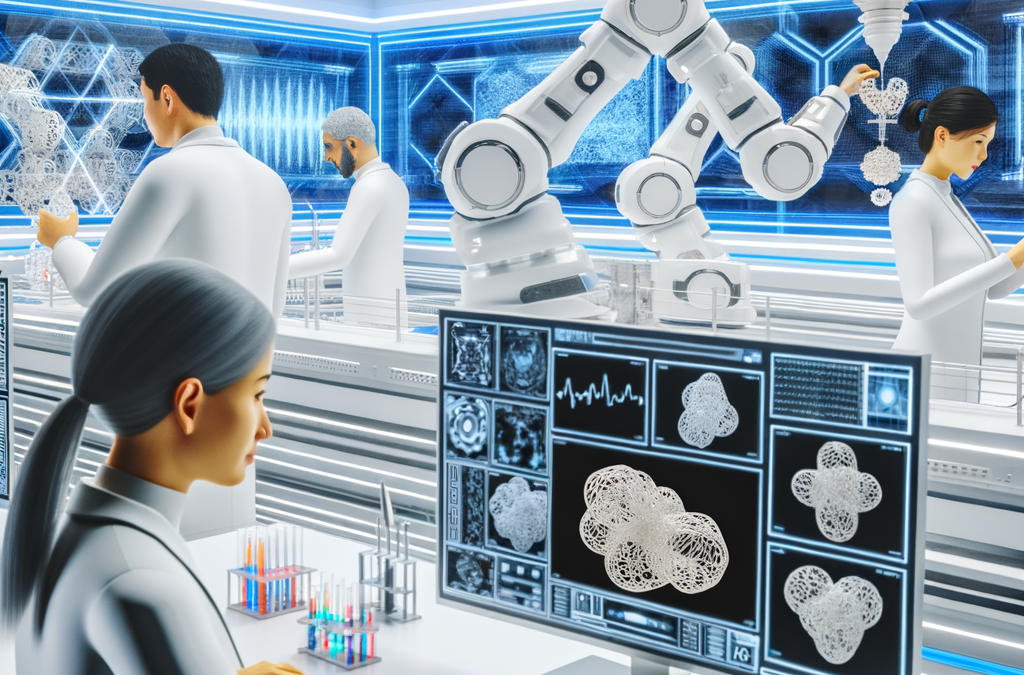
Artificial intelligence (AI) is radically transforming the field of biosciences, revolutionizing areas such as computational biology and bioinformatics. This article explores how machine learning and deep learning are redefining the classification of biological sequences, the prediction of structures, and other critical aspects, driving a new era of innovations in precision medicine and synthetic genomics.
The Impact of Machine Learning on Computational Biology
Computational biology has been one of the most prominent beneficiaries of advancements in artificial intelligence. In this context, machine learning has established itself as an indispensable tool for the classification of biological sequences and the prediction of structures. These processes, which once required considerable time and resources, are now accelerated thanks to advanced AI techniques. Deep neural networks have proven to be particularly effective in tasks such as functional annotation of proteins, where language models and deep learning (DL) techniques enable a more detailed and contextual understanding of complex data. Generative AI, for instance, facilitates the creation of new synthetic biological sequences, providing an innovative approach that enhances experimentation in synthetic genomics.

The prediction of protein structures is another area where AI has demonstrated extraordinary potential. Previously, determining the three-dimensional structure of a protein from its amino acid sequence could take years. Nowadays, thanks to deep learning techniques, this process has become more accessible and efficient. Advanced technological infrastructures and explainable AI models work together to interpret complex models and make the results understandable, marking a new milestone in bioscientific research.
Revolution of precision medicine through AI
The convergence of artificial intelligence and the biosciences is redefining the concept of precision medicine. The ability of AI to analyze vast amounts of genomic and phenotypic data enables personalized diagnostics and treatments. This revolution in precision medicine is driven by causal inference, which allows researchers to identify and understand the complex interactions between genes and phenotypes. Advanced image analysis techniques, combined with AI, are enhancing diagnostic accuracy by identifying subtle patterns in data that might be overlooked by traditional methods.
In addition to enhancing diagnostics, generative AI is being applied to develop new medications and personalized therapies. The rapid development of domain-specific language models facilitates the creation of detailed genetic profiles, which in turn leads to more effective treatment strategies. The synergy of these technologies with the appropriate technological infrastructure promises to significantly improve health outcomes and the quality of life for patients.

AI is therefore driving a paradigm shift in medicine, where the focus is no longer solely on treating symptoms, but on addressing specific underlying causes for each individual. This leads to a new era where each treatment is not only more effective but also more efficient and less invasive, thanks to the understanding and management of complex biological mechanisms through artificial intelligence.
The integration of artificial intelligence in the biosciences offers unprecedented opportunities for advancements in computational biology, precision medicine, and more. Through neural networks and advanced analytics, AI is transforming the way we understand and address biological complexities, paving the way for innovations that promise to surpass the traditional boundaries of science and medicine.
How This Works in Practice
Implementing AI in biosciences involves several structured steps that ensure the effective integration of technology into existing workflows. The first step is identifying the specific problem or research question that AI can address, such as predicting protein structures or analyzing genomic data. This requires collaboration between biologists, data scientists, and AI specialists to define the scope and objectives clearly.
Next, a robust technological infrastructure must be in place, which includes access to high-performance computing resources, data storage solutions, and necessary software tools for machine learning. Organizations often need to invest in cloud computing solutions or high-performance computing clusters to handle the extensive data processing demands of AI applications.
Once the infrastructure is established, the next step involves data collection and preprocessing. This stage is crucial, as the quality of input data directly impacts the performance of AI models. Researchers must ensure that data is cleaned, normalized, and appropriately labeled before being fed into machine learning algorithms. Data should encompass diverse biological parameters to enhance the model’s predictive capabilities.
After preprocessing, the development of AI models begins. This may involve selecting appropriate algorithms, such as deep learning architectures for complex tasks or simpler models for straightforward predictions. The choice of model should align with the specific biological question and the nature of the data. This phase often requires iterative training and validation, where models are adjusted based on performance metrics to ensure accuracy and reliability.
Following model development, the deployment phase involves integrating the AI system into existing research or clinical workflows. This requires training end-users, such as researchers or clinicians, on how to interpret and utilize the AI outputs effectively. Continuous monitoring and evaluation are essential to refine the model further and adapt to new data or changing research questions.
Finally, the results of AI applications in biosciences should be communicated clearly to stakeholders, including researchers, healthcare providers, and patients. This transparency is vital for fostering trust in AI-driven insights and ensuring that the benefits of these technologies are fully realized in practical applications.
What to Watch Out For
While the integration of AI in biosciences presents numerous opportunities, there are several limitations and trade-offs that decision-makers should consider. One significant challenge is the potential for bias in AI models, which can arise from unrepresentative training data. If the data used to train the model does not encompass the diversity of biological systems, the resulting predictions may be skewed and less applicable to broader populations.
Another common mistake is over-reliance on AI outputs without adequate validation. It is essential to complement AI-generated insights with experimental data and expert interpretation to ensure that the conclusions drawn are scientifically sound. This reliance can lead to misinterpretations, particularly in areas where biological complexity is high.
Moreover, the computational requirements for AI applications can be substantial. Organizations must assess their capabilities and resources before embarking on AI projects, as insufficient infrastructure can lead to delays and inefficiencies. This is particularly critical in settings where rapid results are necessary, such as in clinical diagnostics.
Lastly, ethical considerations must not be overlooked. The use of AI in biosciences raises questions about data privacy, consent, and the implications of automated decision-making in clinical settings. Stakeholders must establish clear guidelines and frameworks to address these issues, ensuring that AI applications are used responsibly and ethically.
Frequently Asked Questions
Q: What types of bioscience problems can AI help solve?
A: AI can assist in various bioscience challenges, including protein structure prediction, genomic data analysis, drug discovery, and personalized medicine approaches by analyzing large datasets to uncover patterns and insights.
Q: How do I ensure the quality of data used for AI models?
A: Ensure that data is collected from diverse sources, undergoes rigorous preprocessing to remove noise and inconsistencies, and is properly labeled. Regular audits and updates to the dataset can also improve quality over time.
Q: What skills are necessary for a team implementing AI in biosciences?
A: A multidisciplinary team is essential, including expertise in biology, data science, machine learning, and software engineering. Collaboration among these areas fosters a comprehensive understanding of the problems being addressed.
Q: What are the main ethical concerns regarding AI in biosciences?
A: Key ethical concerns include data privacy, informed consent for data usage, potential biases in AI algorithms, and the implications of automated decision-making in healthcare settings. Establishing clear ethical guidelines is crucial for responsible AI use.