
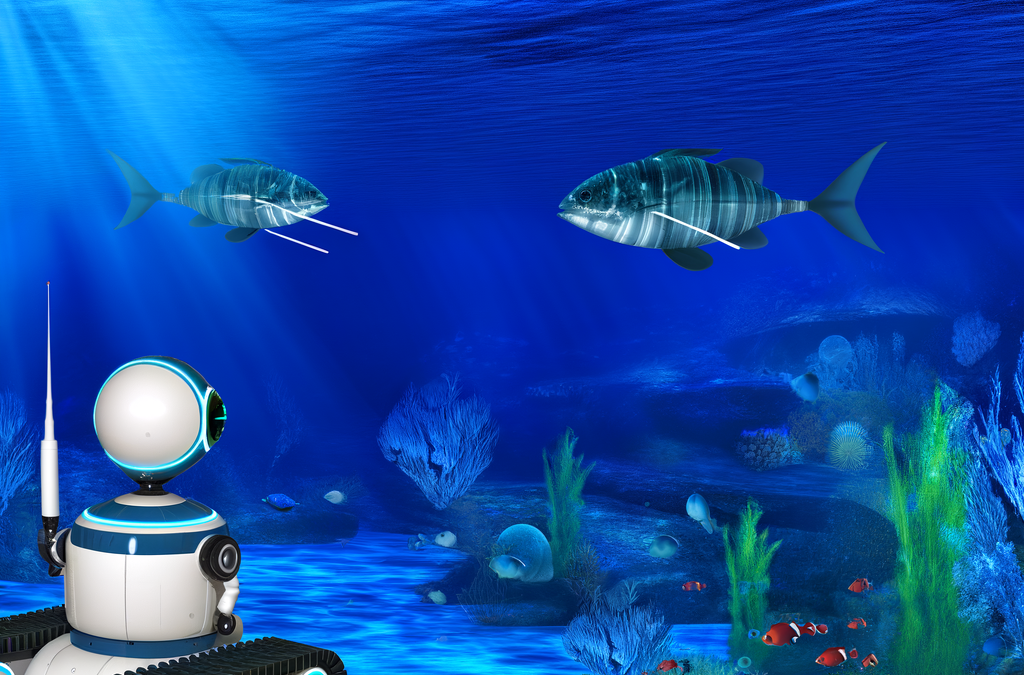
Artificial intelligence (AI) is revolutionizing our understanding of the world, including the depths of the ocean. This article explores how robots equipped with AI are transforming marine research, opening new possibilities for the study of marine life, coral reefs, and underwater ecosystems, and providing marine biologists with more advanced tools for underwater exploration.
Autonomous Robots for Underwater Exploration
The exploration of the ocean has long been a challenge due to its vastness and complexity. Thanks to advancements in artificial intelligence (AI) technology, it is now possible to use autonomous robots to explore underwater areas that were previously inaccessible. These robots, controlled by AI systems, can dive to extreme depths and collect vital data on various oceanic features.
This type of advanced exploration is crucial for learning about complex structures such as coral reefs, which are vital ecosystems for numerous marine species. Robots equipped with AI can map these reefs with millimeter precision, helping to document and analyze how climate change and other threats affect their health.

Moreover, research on underwater volcanoes is another area where autonomous robots have proven to be extremely valuable. These volcanoes often lie hidden beneath the sea, and studying them is essential for understanding the geological and chemical processes of the planet. Thanks to their sophisticated technology, robots can get closer than ever to these natural phenomena, collecting data that would be impossible to obtain by other means.
Impact on Understanding Marine Life
Marine biologists are using artificial intelligence to delve into the study of marine life in ways that were unimaginable just a few decades ago. Robots equipped with AI can discern behavioral patterns among marine species, offering new insights into how they adapt to changes in their environment.
Among these applications, one of the most innovative aspects is the tracking of species movements through automated monitoring. These systems collect vast amounts of data that are analyzed by AI algorithms, enabling researchers to conduct complex studies in real time. This type of research is not only crucial for protecting endangered species, but also for understanding how entire communities are affected by factors such as global warming.

Similarly, the study of sea ice is another area where AI is effectively employed. Robots equipped with advanced sensors are capable of analyzing the composition and structure of sea ice, providing critical data to understand its role in climate change. This information is essential for developing more effective conservation plans and protection policies.
AI and robots are bringing education about the oceans into the 21st century. By creating augmented reality experiences and virtual simulations, students and the general public can now virtually immerse themselves in the ocean, enhancing their understanding and awareness of the challenges facing our marine ecosystems.
In summary, the combination of artificial intelligence and robotics is revolutionizing the way we explore and understand the oceans, from coral reefs to underwater volcanoes. Advances in this field not only benefit marine biologists but also have the potential to significantly impact environmental and educational policies. AI is emerging as an essential tool for the exploration and conservation of marine life.