
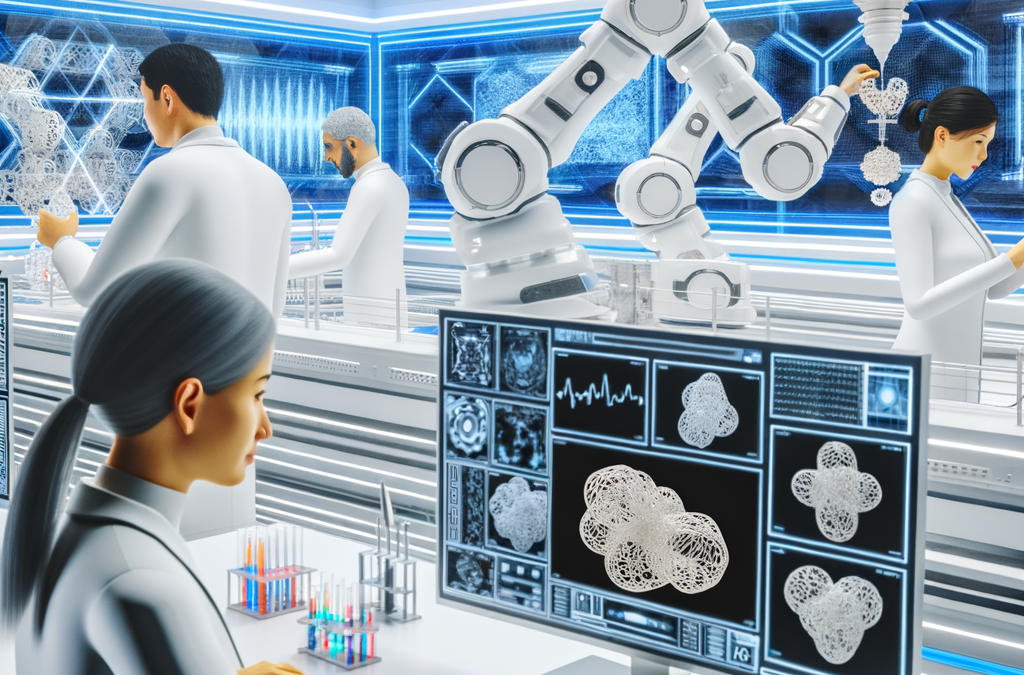
Artificial intelligence (AI) is radically transforming the field of biosciences, revolutionizing areas such as computational biology and bioinformatics. This article explores how machine learning and deep learning are redefining the classification of biological sequences, the prediction of structures, and other critical aspects, driving a new era of innovations in precision medicine and synthetic genomics.
The Impact of Machine Learning on Computational Biology
Computational biology has been one of the most prominent beneficiaries of advancements in artificial intelligence. In this context, machine learning has established itself as an indispensable tool for the classification of biological sequences and the prediction of structures. These processes, which once required considerable time and resources, are now accelerated thanks to advanced AI techniques. Deep neural networks have proven to be particularly effective in tasks such as functional annotation of proteins, where language models and deep learning (DL) techniques enable a more detailed and contextual understanding of complex data. Generative AI, for instance, facilitates the creation of new synthetic biological sequences, providing an innovative approach that enhances experimentation in synthetic genomics.

The prediction of protein structures is another area where AI has demonstrated extraordinary potential. Previously, determining the three-dimensional structure of a protein from its amino acid sequence could take years. Nowadays, thanks to deep learning techniques, this process has become more accessible and efficient. Advanced technological infrastructures and explainable AI models work together to interpret complex models and make the results understandable, marking a new milestone in bioscientific research.
Revolution of precision medicine through AI
The convergence of artificial intelligence and the biosciences is redefining the concept of precision medicine. The ability of AI to analyze vast amounts of genomic and phenotypic data enables personalized diagnostics and treatments. This revolution in precision medicine is driven by causal inference, which allows researchers to identify and understand the complex interactions between genes and phenotypes. Advanced image analysis techniques, combined with AI, are enhancing diagnostic accuracy by identifying subtle patterns in data that might be overlooked by traditional methods.
In addition to enhancing diagnostics, generative AI is being applied to develop new medications and personalized therapies. The rapid development of domain-specific language models facilitates the creation of detailed genetic profiles, which in turn leads to more effective treatment strategies. The synergy of these technologies with the appropriate technological infrastructure promises to significantly improve health outcomes and the quality of life for patients.

AI is therefore driving a paradigm shift in medicine, where the focus is no longer solely on treating symptoms, but on addressing specific underlying causes for each individual. This leads to a new era where each treatment is not only more effective but also more efficient and less invasive, thanks to the understanding and management of complex biological mechanisms through artificial intelligence.
The integration of artificial intelligence in the biosciences offers unprecedented opportunities for advancements in computational biology, precision medicine, and more. Through neural networks and advanced analytics, AI is transforming the way we understand and address biological complexities, paving the way for innovations that promise to surpass the traditional boundaries of science and medicine.