
The intersection between artificial intelligence and video games has revolutionized the way we experience virtual worlds. This article explores how AI is transforming the gaming experience, from the creation of non-playable characters (NPCs) to the generation of entire levels and worlds. Through case studies such as The Sims 4 and Minecraft, we analyze the impact of these technological advancements on the gaming industry.
The Transformation of Non-Playable Characters (NPCs) and Generative AI
Non-playable characters (NPCs) are essential for interaction and immersion within video games. Traditionally, these characters followed predefined patterns, limiting the naturalness of interactions. However, with the introduction of artificial intelligence and more specifically, generative AI, this dynamic has changed drastically. In games like The Sims 4, NPCs are now capable of performing more complex tasks and providing more human-like responses, thanks to the use of advanced neural networks. This not only enhances the player’s immersion but also enriches the game’s narrative, making each experience unique.
Nvidia, with its technologies such as Nvidia Ace, is driving this evolution by providing tools for the development of smarter and more adaptable NPCs. This allows developers to focus on other aspects of design, knowing that AI can handle delivering a personalized gaming experience. This level of customization is becoming increasingly common and essential in titles that aim to offer more interactive and realistic game worlds.
Procedural Generation and the Creation of Dynamic Worlds
Procedural generation is another area where artificial intelligence is making a significant impact. Games like Minecraft and No Man’s Sky are clear examples of how this technique enables the creation of infinite and varied worlds with just a click. The algorithm autonomously generates maps and levels, providing a different experience each time the player enters the game. This advancement not only enhances replayability but also challenges the player to adapt to new situations, organically increasing the difficulty of the game.
In the realm of virtual sports, titles like EA Sports FC 24 are utilizing AI technologies to analyze gameplay patterns and adjust the difficulty in real-time, providing a constant challenge to players of all levels. This dynamic adaptation prevents the game from becoming monotonous, keeping the player’s interest for longer periods.
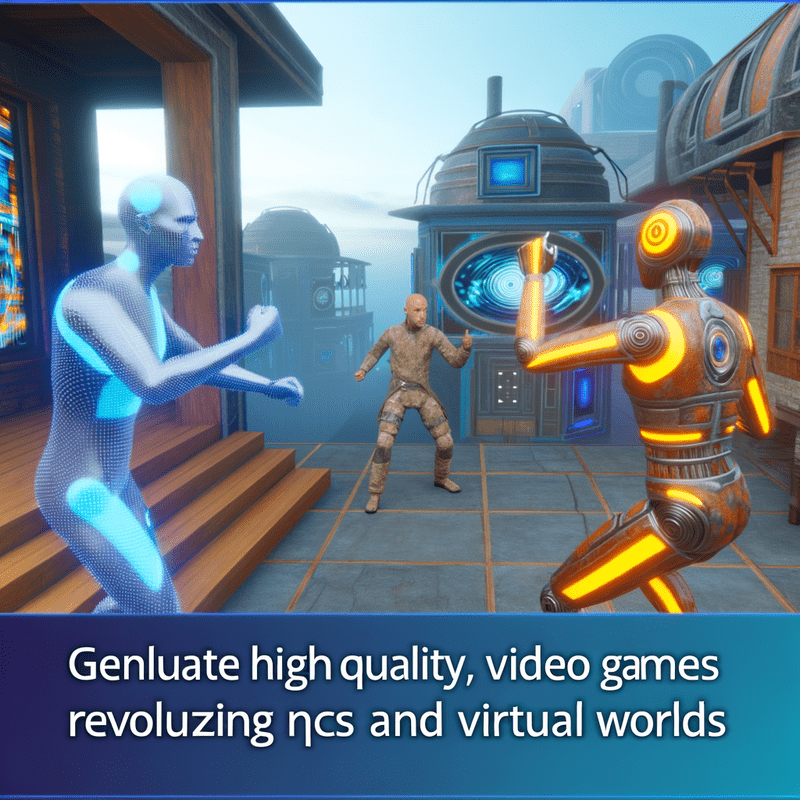
Nvidia has also contributed to the design of virtual worlds with Instant Nerf, a technology that simplifies the representation of complex environments in real time, enhancing visual quality and game performance. These innovations not only enrich the aesthetic experience but also enable developers to create more detailed and vibrant maps, where every corner tells a story.
As artificial intelligence continues to evolve, so does its impact on video games. AI is reimagining interactions with NPCs, the creation of procedurally generated worlds, and in-game difficulty dynamics. These advancements are expanding the boundaries of what is possible in the gaming experience, allowing players to explore worlds never before conceived with unprecedented levels of customization and immersion.