
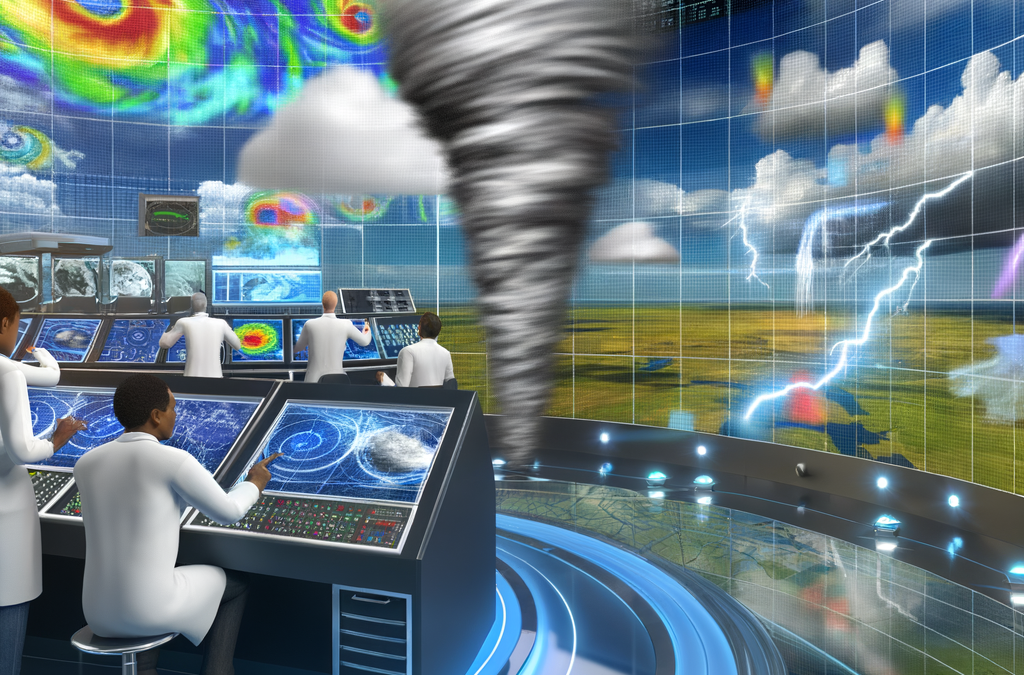
The artificial intelligence (AI) is transforming the way we address climate change, particularly in predicting extreme weather phenomena. Through the use of AI algorithms, neural networks, and deep learning, real-time predictions of events such as hurricanes are being enhanced, thereby improving our ability to prepare for and mitigate impacts on infrastructure and the environment.
The role of artificial intelligence in weather forecasting
Weather forecasting has historically been a complex and challenging field, filled with uncertainties. However, **advancements in artificial intelligence are bringing unprecedented accuracy to climate simulations**. AI algorithms have proven capable of processing vast amounts of data, identifying hidden patterns that traditional weather forecasting models cannot detect. Through **the use of neural networks and deep learning**, simulations have become increasingly precise tools for anticipating phenomena such as hurricanes and storms with a level of foresight that was previously unimaginable.
Particularly, graphical neural networks are gaining traction by simulating complex relationships between climatic variables. These networks allow for modeling how different factors interact in a changing environment, providing new levels of understanding of the climate. **The machine learning enables these systems to continuously improve**, adapting to real-time data and offering updated predictions that are critical for disaster management and contingency planning.
Impact of Enhanced Predictions on Sustainable Development
The advanced predictive capabilities not only benefit weather forecasting itself but also have broader implications for sustainable development. By anticipating extreme weather events with greater accuracy, communities can **implement more effective mitigation strategies**, reducing damage to critical infrastructure and preventing loss of life. Furthermore, improved weather predictions enable more efficient deployment of emergency resources and urban and rural planning with a focus on resilience.
The positive impact extends to the realm of energy sustainability. **The generation of renewable energy is highly influenced by weather conditions,** whether through solar, wind, or hydroelectric power. With improved predictions, the management of these renewable sources becomes more efficient, ensuring a more stable and cost-effective energy supply. Furthermore, this contributes to reducing dependence on fossil fuels, aligning with global sustainability goals and the reduction of global warming.

Finally, these advancements also impact water management, one of our most precious resources. Climate change affects the availability and quality of water, making **more accurate climate simulations vital for hydraulic planning**. By better forecasting precipitation, we can optimize water collection and distribution systems, minimizing waste and ensuring a sustainable supply.
The advancements in artificial intelligence for predicting weather phenomena are revolutionizing our ability to adapt to climate change. By utilizing technologies such as neural networks and deep learning, more accurate predictions are being made that benefit everything from emergency management to energy sustainability, demonstrating the crucial role of AI in sustainable development.