
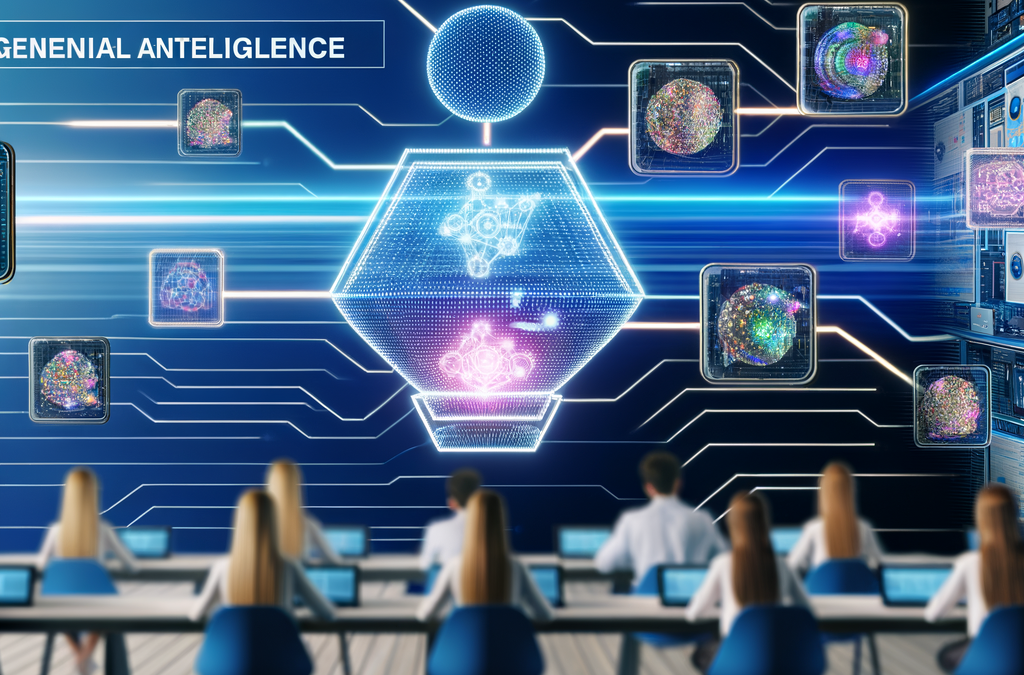
Artificial intelligence (AI) is transforming the educational landscape, particularly through generative AI and its applications. This article explores how this technology is redefining teaching and learning in universities, engaging both students and educators. We will address the opportunities, challenges, and the potential of AI to enrich educational experiences.
The revolution of AI in higher education
The integration of AI in higher education has gone far beyond the mere automation of routine tasks. Thanks to advanced models, generative AI is innovating by creating original and personalized educational content. This advanced digital technology enables universities to generate adaptive learning content that meets the needs of each student, ensuring that everyone receives the appropriate support and resources for their training.
With customizable learning platforms, educators can provide unique educational experiences, fostering a deeper and more meaningful engagement between students and the content. The use of algorithms in predictive AI allows for the identification of patterns in student behavior, anticipating who may need additional support and thereby facilitating personalized assistance.

Moreover, adaptive AI is redefining learning environments by providing interactive simulations and personalized tutoring. These tools not only enhance practical learning but also promote creativity and originality among students. By integrating these technologies, universities like Pearson Higher Education are empowering their students with an education that is more accessible and relevant to the challenges of the future.

Risks and Opportunities of Generative AI in Education
However, the adoption of generative AI in education is not without its risks. One of the main challenges is maintaining a balance between innovation and the human aspect of teaching. An excessive reliance on technology may diminish human interaction, which could negatively impact the development of interpersonal skills. Additionally, there are concerns regarding the quality and originality of the generated content, as well as the accuracy of fully automated assessments.
On the other hand, the opportunities are vast. AI has the potential to democratize education, making information and resources accessible to a broader audience. By offering personalized assessments and tutoring, AI can help close learning gaps, ensuring that no student is left behind. This also allows educators to spend more time on meaningful pedagogical activities and less on administrative tasks.
The creation of high-quality educational content can enhance the educational experience by providing material that is continuously updated with the latest research and technologies. Generative AI also fosters an environment where innovation in teaching is the driving force behind success, equipping students with the skills they need to thrive in an increasingly digital and automated world.
The integration of generative AI in higher education is transforming the way students learn and educators teach, providing new opportunities while posing certain risks. The key to success lies in balancing technology with the human touch, using these tools to enrich educational experiences and better prepare students for the future.