
Contents
If your company is searching “AI software testing” or “AI for QA,” you already know the symptom: every new release takes days to validate because someone has to write test cases by hand, check that last month’s scripts didn’t break with the latest UI change, and chase an intermittent failure that only shows up once in twenty runs. It isn’t that you lack tests — almost every company already has them — it’s that keeping them current costs more time than anyone budgeted for.
What AI actually does in software testing
AI doesn’t “test your software for you.” It automates the repetitive work that today eats hours from someone qualified to do something better than typing test cases one by one.
- Automatic test case generation: starting from requirements or the code itself, it proposes the cases that should be tested, including the edge cases a rushed team tends to leave out.
- Script maintenance (self-healing): when a button moves or a form field changes, the test script updates itself instead of failing red until someone fixes it by hand.
- Risk-based prioritization: instead of re-running the same 500 tests on every release, it identifies which parts of the code the latest change actually touched and concentrates validation there.
- Production data analysis: it spots real user error patterns to feed the next round of test cases, instead of someone guessing them in a meeting room.
None of this closes the testing loop on its own. It proposes and prioritizes; the QA team reviews and confirms, especially anything that doesn’t fit the usual pattern — a new screen, an integration that had never been tested, a result that doesn’t match what was expected.
The real numbers, with their source
The 2026 State of Testing report from PractiTest (the sector’s reference annual survey, verified directly on practitest.com) gives a clear picture of where real adoption stands:
- 76.8% global adoption of AI among testing teams.
- 81.7% at companies with over 10,000 employees, versus 70.6% at businesses with 1-10 employees — the gap isn’t whether AI gets used, it’s the size of the company that can afford to integrate it well.
- 69.6% of AI users apply it to test case generation.
- 59.6% use it for script maintenance.
- Only 19.9% use it for strategic risk identification — the task that delivers the most value is, precisely, the one adopted the least so far.
What nobody says: “we’re trying it” isn’t “we’ve scaled it”
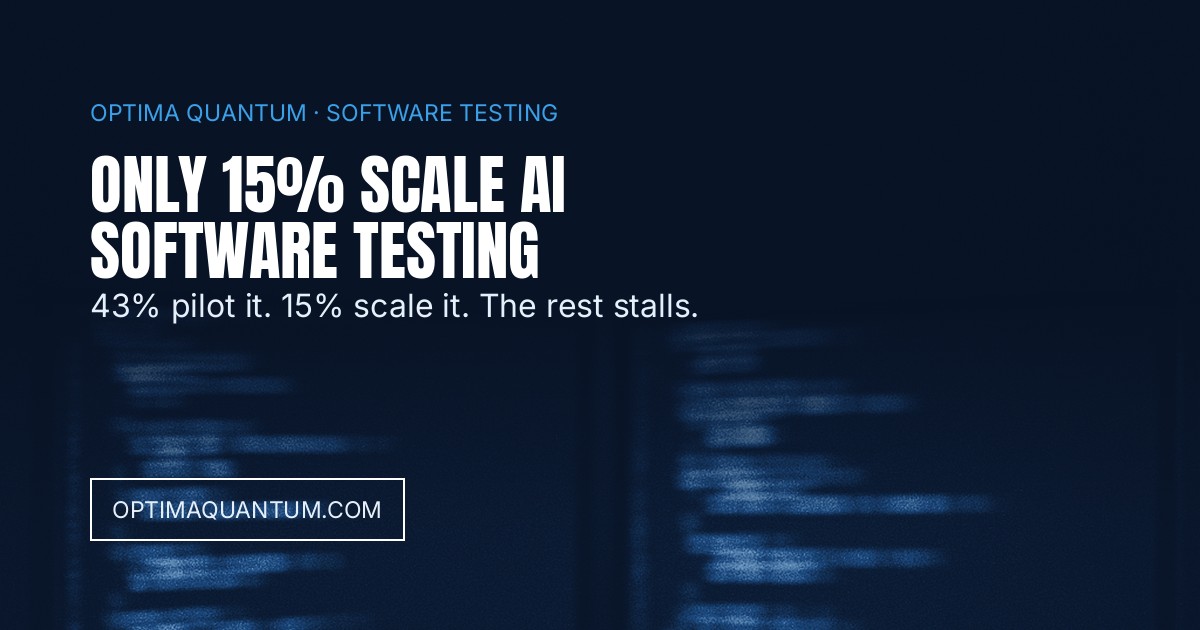
The World Quality Report 2025-26 from Capgemini (verified directly on capgemini.com) puts numbers on the gap this headline opens with: 43% of organizations are experimenting with generative AI in quality engineering, but only 15% have scaled it enterprise-wide. The rest stays stuck in the pilot one team ran a year ago that never made it to any other project.
Why does it get stuck there? The same report points to two concrete blockers, not a generic excuse:
- 60% of organizations struggle to keep test data secure and scalable — testing with AI needs realistic data, and realistic production data usually contains customer information that can’t be used without anonymizing it first.
- 58% cite difficulties integrating AI tools with what they already have running — an isolated pilot is easy; wiring it into a CI/CD pipeline that’s been in production for years is not.
Neither blocker is a problem with AI itself. Both are architecture decisions that need to be made before buying any tool.
What AI doesn’t solve on its own
A test case generated by AI shouldn’t enter the production test suite without someone reviewing it. The risk isn’t so much that AI gets it visibly wrong — that gets caught fast — it’s that it generates a test that looks correct, passes green, and isn’t actually checking what the business needs checked. That’s why the pattern that works is the same one we’ve already seen in AI bookkeeping and every other process we automate: AI prepares and proposes, a person reviews and confirms before it reaches production.
How we do it at Optima Quantum
When we build or maintain software with AI for a client, test generation and maintenance are part of the same engagement, not a line item billed separately: test cases tied to each requirement, scripts that self-correct with interface changes, and execution priority based on what the latest change actually touched. If what your company needs isn’t new software but deciding between a robot that follows fixed steps (RPA) and an AI agent that decides on the fly, we cover that with concrete examples in AI agents vs RPA. And if you’re still comparing which automation tool fits, the rundown is in best AI automation tools.
Frequently asked questions
Does AI replace the QA team? No. PractiTest’s data confirms it: AI gets adopted most where there’s the most repetition (test case generation, script maintenance) and far less where human judgment is required (strategic risk identification, only 19.9%). The QA team stops typing and starts reviewing and deciding.
Do we need to switch testing tools to start? Not necessarily. AI layers on top of whatever testing framework your team already uses — Selenium, Cypress, Playwright or another — the goal is to automate generation and maintenance on top of that base, not replace it overnight.
Why do so many companies get stuck in the pilot and never scale? According to the World Quality Report 2025-26, the two main blockers are secure, scalable test data (60%) and integration with existing tools (58%). Both are architecture problems, not problems with the AI technology itself, and they get solved by planning for them before scaling.
Is this the same as penetration testing? No. Penetration testing checks that a system withstands a deliberate attack; what we cover here is making sure the software does what it’s supposed to without breaking with every change. If what you’re looking for is the former, we cover it in our cybersecurity services.
How long before we see a result? It depends on the size of the test suite, but the first indicator that usually moves is how long the full test round takes to run after each change, before anything else in the process changes.
Talk to us
If your team loses days on every release reviewing tests by hand or chasing failures that only show up sometimes, the first step is looking at how many of those hours go into repetitive work that doesn’t need a qualified person deciding case by case. In AI Automation Services we explain how we set it up; if you’d rather tell us about your case directly, contact us and we’ll look at it with you.
Get our new articles by email
One email per article. Unsubscribe anytime.